

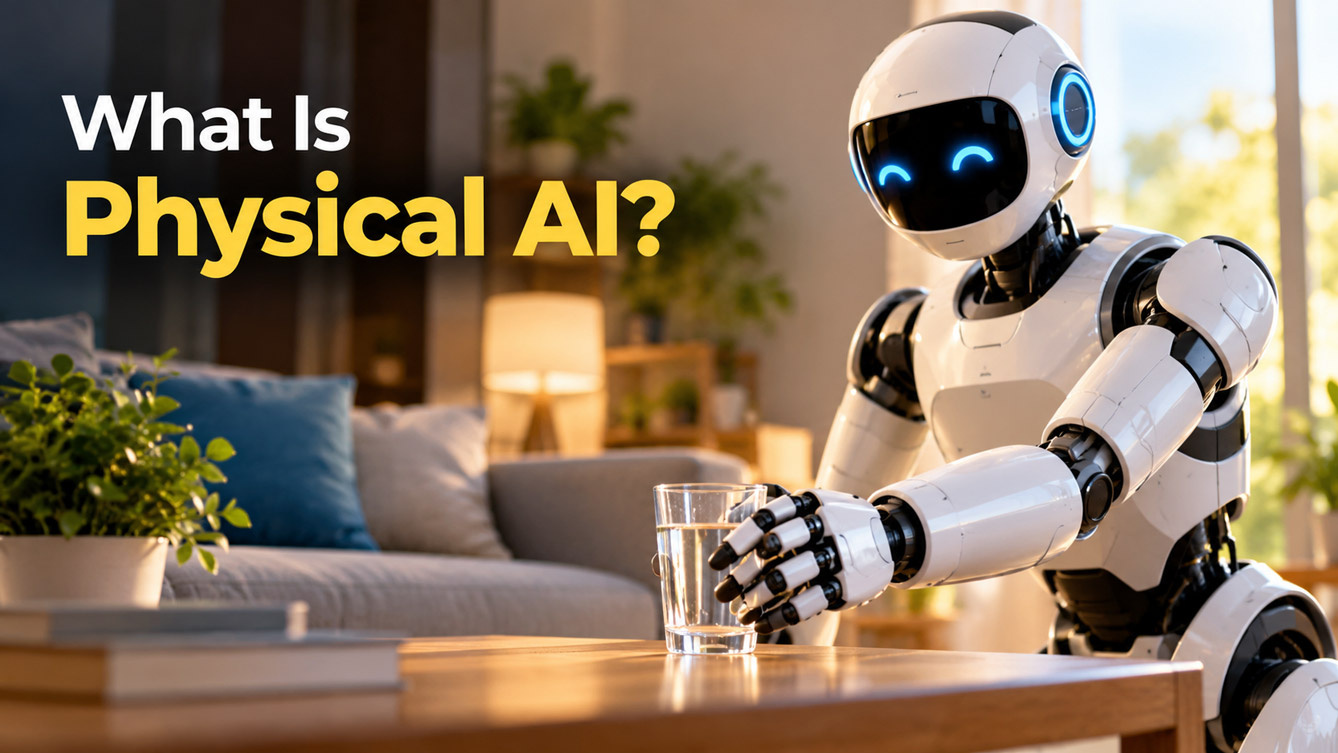
Imagine a robot entering your home, picking up a glass without breaking it, and bringing you a drink. Now imagine that same robot helping an elderly person, organizing a messy room, or working alongside humans in a factory.
Sounds like science fiction?
Not anymore! Artificial intelligence is moving beyond computer screens and entering the physical world. This exciting technology is called Physical AI. But how can a machine learn to handle real objects, avoid obstacles, and respond to unexpected situations?
Can robots develop skills similar to humans?
Let’s explore how Physical AI works and discover why it could change our everyday lives.
What Is Physical AI?
Physical AI refers to artificial intelligence that helps machines understand their surroundings and perform actions in the real world. These machines include humanoid robots, self-driving vehicles, warehouse robots, and intelligent industrial equipment.
Unlike traditional AI tools that mainly process digital information, Physical AI connects intelligence with physical movement. It helps machines observe their surroundings, make decisions, and perform tasks.
Consider a simple example. An AI chatbot can explain how to open a door, but a robot must recognize the door, locate its handle, grasp it, and turn it correctly. Every movement requires information about the physical environment.
In simple words, Physical AI gives machines the ability to understand, decide, and act in the real world.
How Is Physical AI Different from Traditional AI?
Have you ever asked an AI tool to write an email, explain a difficult subject, or create an image? These tools work with digital information and can complete many tasks without moving anything physically.
Physical AI takes this idea further. Instead of simply describing an object, it helps a machine interact with that object.
For example, traditional AI can identify a banana in a photograph. A Physical AI robot must locate the banana, reach toward it, grip it gently, and place it somewhere else.
Here is the main difference:
- Traditional AI: Understands and generates digital information.
- Physical AI: Connects intelligence with actions in the physical world.
However, these technologies can work together. A robot might use a language model to understand spoken instructions and another AI system to control its movements.
How Do Robots Learn to Understand the Real World?
Humans use their eyes, ears, hands, and experience to understand their surroundings. Robots need similar capabilities, although they rely on cameras, sensors, software, and mechanical systems.
Physical AI combines these technologies to help machines respond to different situations. Let’s understand how this process works.
1. Robots Learn Through Cameras and Sensors
Imagine walking into a room filled with chairs, tables, bags, and people. You can recognize these objects and decide where to walk without thinking about every movement.
Robots need technology to perform similar tasks. Cameras help them recognize objects, people, and obstacles. Depth sensors estimate distances, while other sensors detect movement, pressure, and physical contact.
For example, a warehouse robot can use cameras to locate a package. It then estimates the package’s position and determines how to approach it.
These technologies help robots collect information about the world around them.
2. Robots Learn to Make Decisions
Recognizing an object is only the beginning. A robot must also decide what to do next.
Should it move forward, turn left, pick something up, or wait for someone to pass? AI systems help robots choose suitable actions based on their goals and surroundings.
Imagine a delivery robot approaching a crowded walkway. It might slow down, stop, or select another route to avoid people.
Real-world environments constantly change. Someone might suddenly move a chair, or an unexpected obstacle might appear. Therefore, robots must continually update their understanding and adjust their actions.
3. Robots Learn Through Practice
Can a robot improve its skills through practice? Yes! Researchers use several methods to train robots for complex tasks.
One method involves demonstrating a task and recording the movements. Another uses computer simulations, where robots practise inside virtual environments.
Researchers also use reinforcement learning. This method helps an AI system improve its behaviour using rewards or penalties associated with its actions.
Imagine training a robot to pick up a cup. Initially, it might approach from the wrong direction or apply too much pressure. Repeated training can help it discover better movements.
However, learning to handle one cup does not guarantee success with every cup. Different shapes, weights, and surfaces can introduce new challenges.
What Is Embodied AI?
While exploring Physical AI, you may encounter another term: Embodied AI. What does it mean?
Embodied AI focuses on intelligence that interacts with an environment through a body or an agent. That body could belong to a physical robot, or the agent could operate inside a computer simulation.
Physical AI generally emphasizes AI systems that perceive and act in the physical world. The two concepts overlap when researchers train robots to move, manipulate objects, and navigate their surroundings.
For example, a virtual robot might learn to walk through a simulated room before researchers transfer its skills to a real robot.
Simulation reduces the need for repeated physical experiments. Nevertheless, real environments introduce challenges such as uneven surfaces, changing light, and unexpected friction.
How Does a Physical AI Robot Work?
Let’s imagine asking a household robot to bring you a water bottle from the kitchen. How would it complete this task?
The process involves several steps, from understanding your instruction to checking the final result.
Step 1: Understanding Your Instruction
First, the robot needs to understand what you want. An AI model may interpret your request and identify the goal: find a water bottle and bring it to you.
Next, the system can divide the task into smaller actions. These might include locating the kitchen, identifying the bottle, approaching it, picking it up, and returning to you.
Step 2: Observing the Environment
The robot uses cameras and sensors to examine its surroundings. It identifies objects, estimates distances, and determines where it can move safely.
Perhaps it sees two bottles, a chair blocking the walkway, and someone standing nearby. The robot must identify the correct bottle and find a suitable route.
Step 3: Planning the Movement
Now the robot needs to determine how to reach the bottle. Its control systems calculate movements for its wheels, legs, arms, or grippers.
Picking up the bottle requires careful coordination. The robot must position its hand correctly and apply enough force to hold the bottle without crushing it.
Step 4: Taking Action
Once the robot selects its movements, it approaches the bottle and attempts to grasp it. Sensors provide feedback about its position, movement, and contact with the object.
If the bottle slips, the robot may need to adjust its grip. Similarly, an unexpected obstacle might force it to stop or change direction.
Step 5: Checking the Result
Finally, the robot checks whether it has completed the task. Did it pick up the bottle successfully? Is the bottle secure? Has it reached the correct destination?
This feedback helps the robot adjust its next action. The process follows a simple pattern: perceive, decide, act, and check.
By repeating this cycle, Physical AI systems can handle tasks that require continuous interaction with their surroundings.
Why Is Physical AI Growing So Quickly?
Robots have existed for decades, so why has Physical AI attracted so much attention recently? Several technological developments now work together to make robots more adaptable.
More Powerful AI Models
Modern AI models can process text, images, and other forms of information. Researchers are connecting these capabilities with robotic control.
For instance, a robot might receive the instruction, “Move the small box beside the door.” It must understand the words, identify the box, locate the door, and plan the movement.
This connection between language understanding and physical action could make robots easier to instruct.
Better Sensors and Hardware
Modern cameras, depth sensors, motors, and computing systems help robots collect information and control their movements.
Improvements in robotic hands and grippers also help machines handle objects with different shapes and textures.
These developments matter because real-world objects rarely behave as predictably as objects inside a computer simulation.
Training in Simulated Environments
Training a physical robot can be expensive and time-consuming. Simulations allow researchers to practise tasks without repeatedly risking damage to real equipment.
A simulated robot might practise navigating a warehouse thousands of times. Researchers can then test whether its learned skills transfer to the physical world.
Although simulation speeds up development, robots still need real-world testing before they can perform tasks safely.
Learning from Human Demonstrations
Robots can also learn by watching people perform tasks. Researchers may record human movements or guide robots remotely through particular activities.
Imagine showing a robot how to place plates on a table. Instead of manually programming every movement, developers can use demonstrations to help the robot learn.
The robot can then practise the task and adapt its actions to different table layouts.
Real-World Applications of Physical AI
Physical AI is not limited to futuristic humanoid robots. Researchers and companies are developing intelligent robotic systems for several industries.
1. Humanoid Robots
Humanoid robots have body shapes that resemble humans, often including a head, torso, arms, and legs. This design may help them operate in environments built for people.
Companies and research teams are developing humanoid robots for activities such as moving containers, carrying objects, and performing repetitive tasks.
However, walking naturally, recovering from a loss of balance, and handling unfamiliar objects remain difficult challenges. A robot that performs one impressive demonstration may not yet be ready for a full working day.
2. Self-Driving Vehicles
Have you ever wondered how a self-driving car recognizes a pedestrian, responds to a traffic signal, and avoids another vehicle?
Autonomous driving systems combine cameras and other sensors with AI models and control software. They estimate what happens around the vehicle and select appropriate driving actions.
For example, a vehicle may detect a pedestrian approaching a crossing and prepare to stop. It must also account for nearby vehicles, road markings, weather, and unexpected movements.
Self-driving technology demonstrates how AI connects perception with physical action. However, capabilities vary between systems, and safe operation remains essential.
3. Robots in Warehouses
Warehouses offer useful applications for Physical AI because robots must transport goods, navigate aisles, and work around people.
Some robots move packages between locations, while robotic arms pick and sort products. AI helps these systems identify objects, plan routes, and respond to changing conditions.
Imagine a package sitting somewhere unexpected. An adaptable robot can use its sensors to reassess the situation instead of following a completely fixed sequence.
These capabilities can help businesses improve productivity and reduce repetitive physical work.
4. Healthcare and Elderly Care
Could robots eventually help older adults with everyday activities? Physical AI may support tasks such as delivering supplies, transporting equipment, and assisting people in carefully defined situations.
Hospitals already use robots for certain logistical activities. More advanced systems may eventually help with selected physical tasks.
However, helping someone stand, walk, or move safely requires exceptional reliability. Human bodies differ, and mistakes can cause serious injuries. Healthcare robots therefore need appropriate safeguards, supervision, and careful testing.
5. Agriculture and Farming
Farming presents another exciting opportunity for Physical AI. Agricultural robots can use cameras and sensors to identify crops, monitor plant conditions, and perform selected field operations.
For instance, an intelligent robot might distinguish weeds from crops and target weeds for removal. Another system might inspect plants and identify areas that need attention.
Farms contain uneven ground, changing weather, mud, dust, and plants with different shapes. Physical AI can help robots respond to these conditions, although performance depends on the equipment and environment.
6. Robots in Our Homes
Imagine a robot that helps tidy your room, collects laundry, or brings everyday objects to you. Such capabilities could eventually make household robots more useful.
However, homes present unpredictable situations. Toys may lie on the floor, pets may move suddenly, and objects may appear in unfamiliar places.
A robot needs to recognize these changes and adjust its movements. Developers must also consider privacy, safety, cost, and reliability.
For now, many household robots perform specific tasks rather than managing an entire home independently.
What Are AI Foundation Models for Robots?
You may already know about large language models that power modern AI assistants. Researchers are exploring related technologies that connect instructions, visual information, and physical actions.
One example is a vision-language-action model. It combines visual understanding, language instructions, and learned action patterns to help a robot connect what it sees with what it needs to do.
Imagine telling a robot, “Pick up the red toy and place it in the basket.” The model can help identify the toy, interpret your instruction, and generate suitable actions.
However, the model does not handle every responsibility independently. Robots still need motion controllers, sensor feedback, safety checks, and hardware that can carry out the movements.
Researchers hope these models will reduce the need to programme every new activity separately. This could make robots more adaptable to unfamiliar objects and tasks.
What Are the Biggest Challenges Facing Physical AI?
Despite its potential, Physical AI still faces significant challenges. The real world constantly presents situations that developers cannot predict in advance.
1. Understanding Unexpected Situations
A robot trained in a clean laboratory may struggle in a cluttered room. Poor lighting, unusual objects, and unfamiliar environments can confuse its perception systems.
Developers must train robots across diverse conditions and help them recognize situations where they lack enough information to act safely.
2. Handling Objects Like Humans
Humans can pick up a paper cup, turn a door handle, or fold a shirt using flexible movements and a sense of touch. Robots often struggle with these activities because objects differ in shape, weight, softness, and friction.
A robot might handle a rigid box easily but struggle with a slippery bottle or a piece of clothing.
Better robotic hands, touch sensors, and movement controls could help solve these problems.
3. Staying Safe Around People
A robot must understand that a nearby person is not simply another obstacle. It needs to anticipate movement, avoid collisions, and respond when someone enters its path.
Safety becomes especially important in homes, hospitals, factories, and public spaces. Developers must combine intelligent behaviour with physical safeguards, emergency stops, testing, and appropriate supervision.
4. Managing Costs and Energy
Advanced robots need motors, sensors, batteries, computing hardware, and regular maintenance. These components can make robotic systems expensive to purchase and operate.
Complex AI models may also require substantial computing power. Developers must balance intelligence, speed, battery life, and cost to create practical products.
5. Moving from Simulation to Reality
A robot may perform perfectly in a virtual environment but struggle with real-world friction, uneven surfaces, or changing light. Researchers call this challenge the simulation-to-reality gap.
To reduce this gap, they combine simulated training with physical testing and adjustments. Even then, each new environment can introduce challenges that require additional evaluation.
Will Physical AI Replace Human Jobs?
This is one of the biggest questions surrounding intelligent robots. As machines learn to perform more physical tasks, industries may change how they organize work.
Robots could take over repetitive, physically demanding, or dangerous activities. In factories, for example, they might transport heavy materials or perform repetitive handling tasks.
Such changes could reduce physical strain and allow employees to focus on quality control, planning, and problem-solving.
However, automation may reduce demand for certain roles. Workers may need to develop new skills to operate, maintain, supervise, and improve robotic systems.
The outcome will vary across industries and occupations. Rather than assuming robots will replace every worker, we should examine which tasks machines can perform reliably and which still require human judgment, creativity, empathy, or flexibility.
Preparing workers through training and responsible adoption will play an important role in this transition.
How Will Physical AI Change Our Daily Lives?
Physical AI could gradually bring artificial intelligence beyond our phones and computers. Instead of asking an assistant for instructions and performing every action ourselves, we may increasingly work with machines that can complete selected tasks.
At home, robots might help with cleaning, organizing, and carrying objects. In factories, they could work alongside employees and adapt to changing production needs.
Agricultural robots may help farmers monitor crops, while intelligent machines could support people with disabilities by helping them interact with objects.
However, these benefits depend on affordability, accessibility, reliability, and safe design. We should not expect every home to have a human-like robot overnight.
Progress will probably happen gradually. Specialized robots may become useful before general-purpose machines can handle many different activities.
The biggest change may come when robots stop performing just one fixed task and start adapting to everyday situations.
What Does the Future of Physical AI Look Like?
The future of Physical AI depends on how well researchers connect intelligence with reliable movement. More capable AI models may help robots understand natural instructions, recognize unfamiliar objects, and learn tasks from demonstrations.
Meanwhile, improvements in hardware, tactile sensing, batteries, and motion control could make robots more practical. Better simulation tools may also help developers test more situations before deploying machines in real environments.
Imagine a robot that notices you carrying shopping bags and offers to place them on the kitchen counter. Picture a factory robot that recognizes a new package shape and adjusts its grip after checking whether it can handle the object safely.
These examples represent possible future capabilities, not guaranteed outcomes. Real progress will require careful engineering, extensive testing, and clear safety standards.
One thing is clear: the next stage of AI development will involve more than generating convincing text or realistic images. It will increasingly focus on helping machines interact with the world around us.
Conclusion: When Artificial Intelligence Learns to Act
Physical AI brings a fascinating idea closer to reality: machines that connect what they understand with what they do. By combining cameras, sensors, learning systems, and physical movement, researchers are helping robots become more adaptable and useful.
Although major challenges remain, progress in robotics could transform manufacturing, farming, healthcare support, transportation, and everyday living. The journey will require patience, responsible development, and a clear understanding of what machines can safely accomplish.
Think about the next time you use an AI chatbot. Today, it might explain how to clean your room, repair a machine, or organize your workspace. In the future, a robot might help you perform some of those tasks in the real world.
If AI could give a robot just one useful skill to help you every day, what would you choose? Would you ask it to cook, clean, assist older family members, or help you at work? Share this article with your friends and colleagues, and ask them the same question. Their answers might reveal just how differently we imagine our future with intelligent machines.
Frequently Asked Questions (FAQs)
1. What is Physical AI in simple words?
Physical AI is artificial intelligence that helps machines understand their surroundings and perform actions in the real world. Examples include intelligent robots, autonomous vehicles, and robotic systems that handle objects.
2. How do robots learn to interact with the real world?
Robots learn through training data, human demonstrations, simulations, reinforcement learning, and physical practice. Cameras and sensors provide feedback that helps them adjust their actions and improve their performance.
3. What is the difference between Physical AI and Generative AI?
Generative AI creates content such as text, images, audio, and video. Physical AI connects intelligence with physical actions, allowing machines to move, handle objects, and interact with their surroundings. Some robotic systems use generative AI as part of their intelligence.
4. Where can we use Physical AI?
Physical AI can support manufacturing, warehouses, agriculture, transportation, healthcare logistics, and household assistance. Its usefulness depends on the robot’s capabilities, operating environment, and safety requirements.
5. Will Physical AI robots replace humans?
Physical AI may automate certain repetitive, physically demanding, and dangerous tasks. However, many activities still require human judgment, creativity, empathy, and adaptability. Its impact will depend on how businesses adopt robotics and how workers adapt to changing job requirements.