

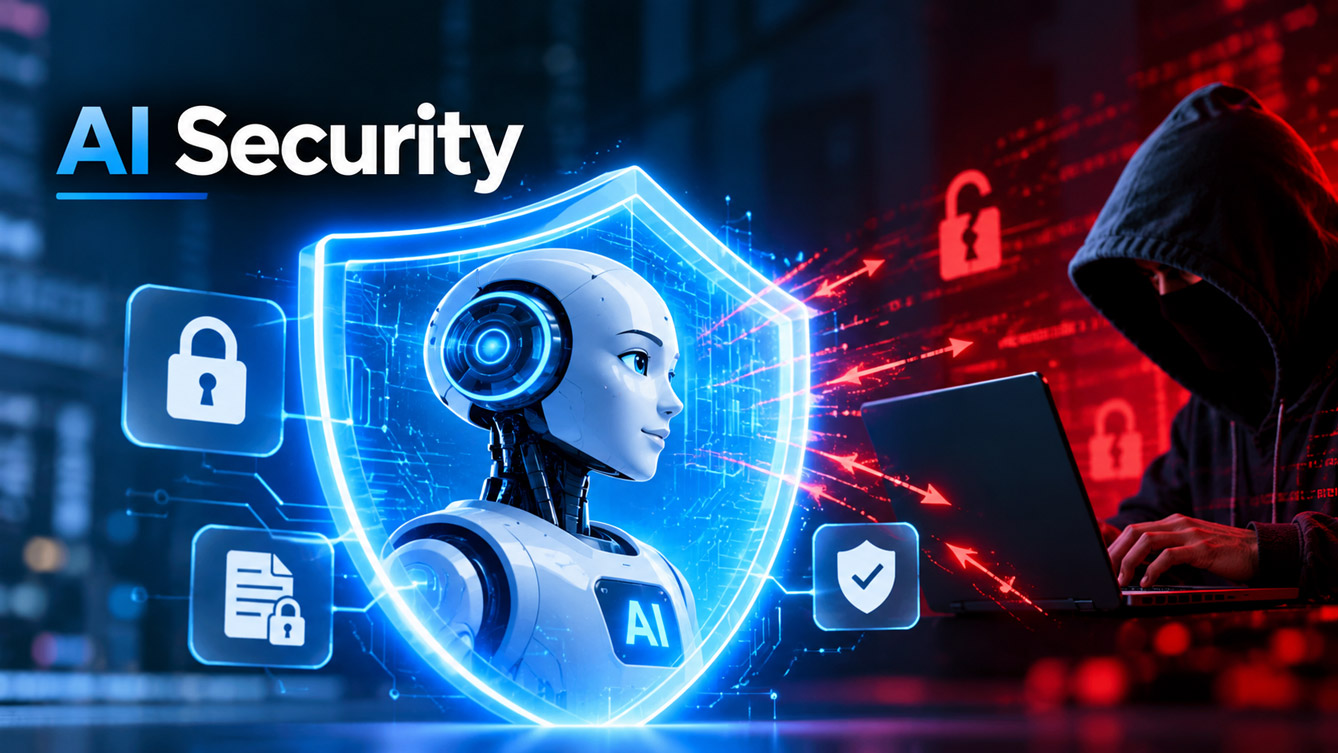
Imagine asking an AI assistant to manage your emails, analyse business data, or handle customer information. It completes your tasks in seconds. But what if a hacker tricks that same AI into revealing your private information? Would you still trust it? As artificial intelligence becomes part of our daily lives, protecting it from cyberattacks has become more important than ever. This is where AI security comes in.
What Is AI Security?
AI security refers to the methods and tools that protect artificial intelligence systems from hackers, data theft, and harmful manipulation. It helps keep AI systems safe, reliable, and trustworthy.
Think of AI as a smart employee who processes information and makes recommendations. Just as you protect your office files and computers, you must also protect the AI systems that handle your information.
However, AI security goes beyond traditional computer security. Attackers may target an AI system’s training data, behaviour, or decision-making process.
For example, a hacker might try to make a banking AI reveal confidential customer details. AI security helps prevent such attacks and reduces the damage they could cause.
Why Does AI Security Matter Today?
Have you noticed how quickly AI tools have entered our lives? People now use AI to write emails, create images, answer questions, and automate business operations.
Hospitals, banks, schools, and online stores also use AI to improve their services. However, these systems may handle sensitive information, including financial records and personal details.
Imagine a company using AI to manage customer support. If a hacker tricks the system into exposing customer records, the company could lose money and damage its reputation.
Therefore, AI security protects more than technology. It also protects people’s privacy, business operations, and trust.
How Is AI Security Different from Cybersecurity?
You may already know the term cybersecurity. It involves protecting computers, networks, websites, applications, and digital information from cyberattacks.
AI security overlaps with cybersecurity, but it also addresses risks specific to artificial intelligence. Attackers may manipulate an AI system even when the surrounding website or network remains secure.
For instance, a website may have strong passwords and a firewall. However, an AI chatbot on that website might still follow malicious instructions hidden inside a message.
In simple terms, cybersecurity protects digital systems, while AI security also protects how AI learns, responds, and makes decisions. Both work together to improve digital safety.
7 Major Security Threats That Can Attack AI Systems
Understanding the risks makes AI security easier to understand. Let’s explore seven common threats and see how attackers might exploit AI systems.
1. Prompt Injection: Tricking AI with Hidden Instructions
Have you ever asked an AI chatbot a question and received an unexpected answer? Attackers can deliberately design instructions to manipulate an AI’s behaviour. This technique is called prompt injection.
Imagine an AI assistant that reads and summarises emails. A hacker sends an email containing malicious instructions that encourage the AI to reveal confidential information.
If the AI follows those instructions, it may expose information that should remain private. Developers must separate trusted instructions from untrusted content and restrict the AI’s permissions.
2. Data Poisoning: Teaching AI the Wrong Things
AI systems learn patterns from data. During training, developers provide examples that help models recognise information, answer questions, and make predictions.
But what happens if someone secretly adds misleading information to the training data? This attack is known as data poisoning.
Imagine training an AI system to detect fraudulent bank transactions. An attacker introduces misleading examples that teach the system to overlook certain scams.
To reduce this risk, organisations should check training data carefully. They should also restrict access to datasets and test models for unusual behaviour.
3. Data Leakage: When AI Reveals Private Information
AI tools often work with customer records, internal documents, and confidential business information. Poor security controls can allow these systems to expose sensitive details.
Suppose a company connects an AI assistant to its internal files. If the assistant fails to check user permissions, it might reveal confidential documents to unauthorised employees.
Attackers may also use carefully designed questions to extract sensitive information from some AI systems. In addition, poorly configured applications may expose data through logs or connected services.
Businesses can reduce these risks by limiting data access, removing unnecessary personal details, and regularly reviewing security settings.
4. Adversarial Attacks: Fooling AI with Misleading Inputs
Sometimes, attackers do not need to steal passwords or break into a computer. Instead, they manipulate the information that an AI system examines.
These attacks are known as adversarial attacks. Carefully designed changes to an image, sound, or other input can cause an AI model to make incorrect predictions.
For example, an AI system might recognise road signs for a self-driving vehicle. A carefully manipulated sign could confuse the system, even when a human driver recognises it correctly.
Developers should test AI models against unusual inputs. They should also add extra safety checks when incorrect predictions could harm people.
5. Model Theft: Stealing an AI System’s Capabilities
Imagine spending months developing a valuable AI system for your business. You invest time, money, and expertise to make it work. Then, an attacker tries to copy its capabilities.
This threat is known as model theft or model extraction. Depending on the system, attackers may repeatedly query an AI service to build a substitute model.
Model theft can damage a company’s competitive advantage and expose valuable intellectual property. Businesses should protect model files, secure development systems, and monitor unusual requests.
6. Deepfakes and AI-Powered Scams
Have you ever watched a video or heard a voice recording that seemed completely real? AI can now generate convincing images, videos, and voices.
Cybercriminals can misuse these capabilities to impersonate company directors, employees, or family members. For example, a fraudster might use a cloned voice to request an urgent money transfer.
The voice may sound familiar, but the person making the request could be a criminal. Therefore, always verify unusual payment requests through a separate, trusted communication channel.
7. Unauthorised Access to AI Tools
AI applications often connect to databases, cloud services, email platforms, and business software. These connections help AI complete tasks, but they also create additional security risks.
Consider an AI assistant that can read emails, update customer records, and create invoices. If a hacker steals an account password, the attacker might misuse those capabilities.
Businesses should use strong authentication and carefully control permissions. They should also require human approval for sensitive actions, such as transferring money or deleting important records.
How Do We Protect AI Systems from Hackers?
Now that we understand the major threats, let’s explore practical ways to protect AI systems. Organisations can reduce many risks by combining established cybersecurity practices with AI-specific safeguards.
1. Use Strong Passwords and Multi-Factor Authentication
Every secure AI system needs strong access controls. Weak passwords can allow attackers to access AI tools and misuse confidential information.
Businesses should require long, unique passwords and enable multi-factor authentication (MFA). MFA asks users to provide another form of verification, such as an authentication-app code or security key.
Even if a hacker steals an employee’s password, MFA can make account access more difficult. Organisations should also remove unused accounts and revoke access when employees leave.
2. Protect Sensitive Information from Untrusted AI Tools
Would you upload your bank statements or confidential business plans to any free AI website without checking its privacy practices? Probably not.
Before using an AI service, check how the provider handles your information. Review its privacy policy, data retention practices, and security controls.
Companies should establish clear rules about which AI tools employees can use. They should also avoid sharing unnecessary personal details or confidential business information.
3. Encrypt Data to Make It Harder to Steal
Encryption converts readable information into a protected form that requires the appropriate key to decode. It helps protect sensitive data during storage and transfer.
For example, encryption can protect customer information stored in a database. It can also protect information moving between an AI application and its server.
However, encryption alone cannot prevent every attack. Organisations should combine it with access controls, monitoring, and secure account management.
4. Test AI Systems Before Releasing Them
Would you allow a new car onto the road without testing its brakes? Similarly, developers should test AI systems before releasing them to users.
Security testing should examine whether attackers can manipulate prompts, extract private information, or bypass restrictions. Developers should also check how the AI responds to unfamiliar situations.
For high-risk systems, organisations can arrange independent security assessments and AI red-team exercises. These tests help identify weaknesses before criminals exploit them.
Regular testing remains essential because AI models, connected tools, and attack techniques continue to change.
5. Give AI Only the Permissions It Needs
An AI system should not receive unlimited access simply because it can perform many tasks. Developers should follow the principle of least privilege.
This principle means giving each system only the permissions necessary for its work. For example, an AI assistant that summarises customer feedback probably does not need permission to issue refunds or delete customer accounts.
Limiting permissions reduces the damage an attacker could cause if the AI behaves unexpectedly. Businesses should also require human approval for sensitive or irreversible actions.
6. Monitor AI Behaviour and Investigate Unusual Activity
Security teams should watch for signs that someone is misusing an AI system. These signs may include unusual numbers of requests, repeated attempts to access restricted information, or suspicious account activity.
Monitoring helps organisations detect potential attacks earlier. However, teams must also protect monitoring records because logs may contain sensitive information.
Businesses should establish clear response procedures. Depending on the risk, they may need to block an account, restrict a tool, investigate affected records, or temporarily disable an AI feature.
7. Keep AI Software and Supporting Systems Updated
AI security does not end when developers launch a product. The software, libraries, cloud services, and external tools supporting the AI may contain vulnerabilities.
Developers should install security updates, remove outdated components, and review third-party services regularly. They must also protect the systems that store AI models and training data.
For example, an AI application may use a vulnerable software library even when its own code appears secure. Attackers could exploit that weakness to compromise the application.
Regular maintenance helps organisations identify and fix problems before they become serious incidents.
8. Use Human Oversight for Important Decisions
AI can analyse information quickly, but it can still make mistakes or produce misleading answers. Therefore, organisations should include human oversight when AI handles money, medical information, legal matters, or critical systems.
Imagine an AI tool that flags a payment as suspicious. Instead of automatically blocking every transaction, the organisation could send high-risk cases to a trained employee for review.
Human oversight does not require someone to check every AI response manually. Instead, organisations should identify situations where human judgement can prevent serious errors or abuse.
9. Create a Clear AI Security Policy
Technology alone cannot protect an organisation. Employees also need to understand how to use AI responsibly.
An AI security policy should explain which tools employees can use and what information they may share. It should also define who approves new AI applications and how employees report suspicious activity.
Businesses should train employees to recognise prompt injection, deepfake scams, and accidental data exposure. Regular awareness sessions can turn security into a shared responsibility.
What Is AI Red Teaming, and Why Does It Matter?
AI red teaming involves security specialists testing an AI system to discover weaknesses. They act like potential attackers, but they work with permission and follow an agreed testing plan.
For example, a red team might try to trick a chatbot into revealing confidential information. It might also test whether the AI follows malicious instructions or misuses connected tools.
The team records its findings and recommends improvements. Developers can then fix weaknesses and repeat the tests to check whether their changes work.
Red teaming becomes especially important when organisations use AI to handle sensitive data or perform actions on behalf of users.
Can AI Protect Us from Other Hackers?
Here is an interesting twist: AI does not only face cyberattacks. It can also help defend against them.
Security teams use AI-powered tools to examine large amounts of activity and identify suspicious patterns. These tools can help detect unusual login attempts, identify potential fraud, and analyse malicious software.
For example, an AI-based detection system can analyse millions of transactions and flag activity that deserves further investigation. This capability helps security teams focus on potential threats.
However, defenders should not blindly trust AI-generated alerts. AI tools can make mistakes, and attackers may manipulate them. Human expertise and established security controls remain essential.
The strongest defence combines AI’s speed with human judgement and proven cybersecurity practices.
Who Is Responsible for AI Security?
You might think AI security is only the responsibility of software developers or large technology companies. In reality, everyone who builds, provides, or uses AI has a role to play.
AI developers should design secure systems, test their models, and protect training data. They must also limit dangerous capabilities.
Businesses should choose trustworthy AI providers, control access to sensitive information, and train employees. They should also establish clear security policies.
AI service providers should protect their infrastructure, manage vulnerabilities, and offer appropriate security controls. They should also explain important limitations to customers.
Everyday users should avoid sharing confidential information with untrusted tools. They should protect their accounts, verify suspicious requests, and report unusual behaviour.
When everyone takes responsibility, AI systems become safer and more reliable.
What Does the Future of AI Security Look Like?
AI will continue to influence how people work, learn, communicate, and manage businesses. At the same time, attackers will search for new ways to exploit intelligent systems.
In the future, organisations will need stronger protection for AI agents that interact with websites, send messages, and complete business tasks. These agents can save time, but excessive permissions or malicious instructions could create serious risks.
Security teams will also need better ways to protect private training data and detect AI-generated impersonation. They must also improve their understanding of how AI systems make important decisions.
Governments, technology companies, researchers, and businesses will all contribute to improving AI security. Nevertheless, no single tool can eliminate every risk.
Organisations that prepare early, test regularly, and treat security as an ongoing responsibility will be better positioned to use AI safely.
Conclusion: Can We Trust AI Without Protecting It?
Artificial intelligence offers exciting possibilities, from faster customer service to better fraud detection and smarter business operations. Yet every new capability can introduce risks when attackers find ways to misuse it.
AI security helps protect intelligent systems from manipulation, data theft, unauthorised access, and other emerging threats. Strong passwords, encryption, careful data handling, regular testing, limited permissions, and human oversight all play important roles.
Most importantly, remember that trust in AI does not come from intelligence alone. It comes from building systems that protect people, respect privacy, and behave responsibly.
The next time you use an AI tool, have you ever wondered how safely it handles your information? If AI security affects everyone who uses technology, shouldn’t more people understand it? Share this article with your friends, family, colleagues, and business owners. Your next conversation about AI might help someone recognise a threat before it becomes a costly mistake.
Frequently Asked Questions (FAQs)
1. What is AI security in simple words?
AI security means protecting artificial intelligence systems from hackers, data theft, malicious instructions, and other cyber threats. It helps keep AI systems safe, reliable, and trustworthy.
2. Can hackers attack AI systems?
Yes. Hackers can target AI systems through prompt injection, data poisoning, stolen accounts, malicious inputs, and software vulnerabilities. They may also try to steal AI models or extract confidential information.
3. How can we protect AI systems from hackers?
Organisations can protect AI systems with strong passwords, multi-factor authentication, encryption, regular security testing, limited access permissions, software updates, and continuous monitoring. They should also review AI-generated actions before allowing sensitive operations.
4. What is the difference between AI security and cybersecurity?
Cybersecurity protects computers, networks, applications, and digital information. AI security also addresses threats involving training data, model behaviour, malicious prompts, and AI-generated decisions. Both work together to improve digital safety.
5. Can AI help prevent cyberattacks? Yes. AI can help security teams detect suspicious activity, identify potential fraud, analyse malicious software, and investigate unusual patterns. However, AI tools can make mistakes, so organisations should combine them with human expertise and established security measures.