

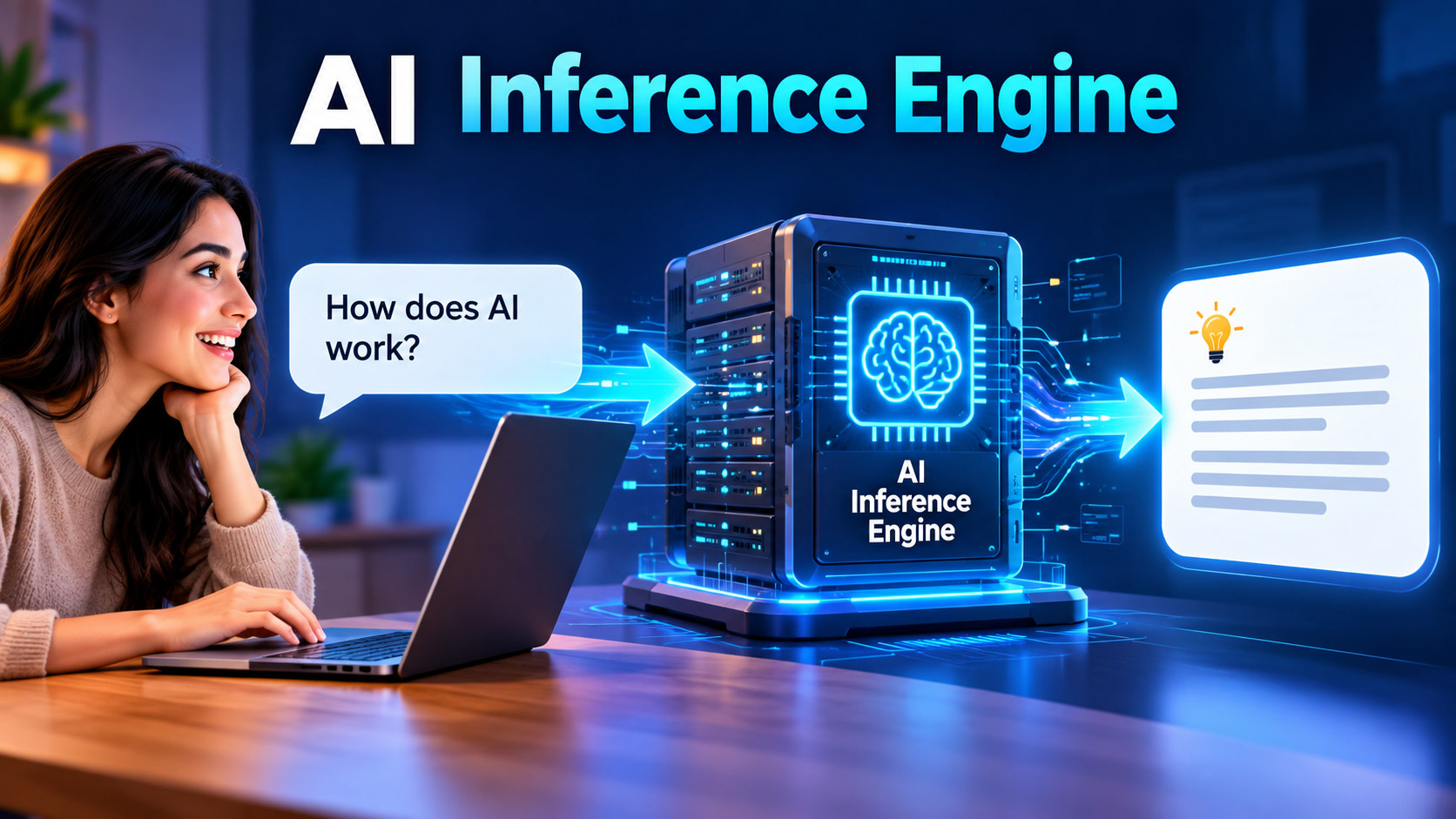
Have you ever asked ChatGPT a difficult question and received a detailed answer in just a few seconds?
Perhaps you asked it to explain a complicated topic, write an email, solve a problem, or even create a story. But have you ever wondered what happens behind the screen during those few seconds?
How does artificial intelligence understand your question, choose the right words, and generate an answer so quickly?
The secret lies in several powerful technologies working together, including something called an AI inference engine. In this article, we will explore this fascinating technology in simple English and discover how AI turns your questions into answers almost instantly.
What Is an AI Inference Engine?
An AI inference engine helps an artificial intelligence system use what it learned during training to produce useful results. Think of it as the technology that helps an AI model put its knowledge into action.
Imagine teaching a student mathematics for several months. During that time, the student learns formulas, understands concepts, and solves many practice problems. Later, when you give the student a new question, the student uses that knowledge to find an answer.
AI follows a similar principle, although it uses mathematical calculations instead of human thinking.
During AI training, developers teach a model using enormous amounts of data. Once training finishes, the model can use its learned patterns to respond to new inputs. The inference process makes that possible.
For example, when you ask an AI chatbot,
“Why does the moon appear brighter at night?”, the system processes your question and generates a suitable response. The inference engine helps execute the model’s calculations efficiently.
In simple terms, AI training teaches a model, while AI inference allows the model to use what it has learned.
What Does the Word Inference Actually Mean?
Before going deeper, let’s understand the word “inference.”
In everyday life, we make inferences all the time. Suppose you look outside and see dark clouds, strong winds, and people carrying umbrellas. You might conclude that rain is coming, even if you haven’t seen a single raindrop.
You reach that conclusion using information and patterns you already know.
AI inference follows a related idea. An AI model receives information, processes it using learned patterns, and produces a prediction or result. However, an AI model does not necessarily understand that information the way a human does.
For instance, an image recognition system might identify a cat in a photograph. A voice assistant might turn spoken words into text. Meanwhile, a chatbot might predict the next word in a sentence and continue generating an answer.
Each example uses inference, but the underlying technology can differ.
AI Training vs. AI Inference: What Is the Difference?
Have you ever wondered whether ChatGPT learns everything again whenever you ask a question? The answer is no.
AI training and inference serve two different purposes. Understanding this difference makes the entire process much easier to understand.
AI training is the learning stage. Developers use large datasets and extensive computing resources to adjust a model’s internal parameters. The model gradually learns patterns in language, images, code, or other types of information.
AI inference is the response stage. The trained model processes new information and produces an output. For example, it might answer your question, summarize a document, or describe an image.
Consider a simple comparison. A chef spends years learning recipes, ingredients, and cooking techniques. When a customer places an order, the chef uses that experience to prepare a dish. The chef doesn’t repeat every lesson before making each meal.
Similarly, an AI model uses the patterns it learned during training to respond to your request.
| Feature | AI Training | AI Inference |
| Main purpose | Learn patterns from data | Produce results using learned patterns |
| When it happens | During model development or additional training | Whenever the model processes a request |
| Computing needs | Often extremely intensive | Depend on the model and workload |
| Example | Teaching a model language patterns | Generating a chatbot response |
Therefore, when you ask an AI a question, the system generally doesn’t train the entire model from scratch. It runs inference using an already-trained model.
How Does an AI Inference Engine Work?
Now that we understand inference, let’s explore what happens when you send a question to an AI chatbot.
Although different AI systems use different architectures, a typical language model follows a series of steps to generate its response.
Step 1: You Enter a Question
Everything begins when you type a question into an AI application.
For example, imagine asking, “How does a computer understand human language?”
The application sends your message to the AI service. Depending on the system, the service may also consider previous messages, system instructions, and other relevant context.
The AI doesn’t immediately process your sentence as a human reader would. First, it needs to convert the text into a form that its model can handle.
Step 2: The System Converts Your Words into Tokens
Have you heard the word “token” in discussions about AI? Tokens play an important role in how language models process text.
A token represents a small unit of text. It might contain a complete word, part of a word, punctuation, or another piece of text. The exact division depends on the model’s tokenizer.
For example, a short sentence might become several tokens rather than one token for every complete word.
Think of tokens as building blocks. Instead of handling an entire paragraph as one enormous piece, the model processes a sequence of smaller units.
The tokenizer converts your message into token IDs. These IDs allow the model to work with your text mathematically.
Interestingly, the number of tokens doesn’t always match the number of words. A familiar word might use one token, while an uncommon word could require several.
Step 3: The AI Model Processes Your Question
Once the system converts your message into tokens, the model begins its main calculations.
Many modern chatbots use a model architecture called a transformer. This architecture helps the model identify relationships between different parts of the input.
For example, consider the sentence, “Ravi placed the glass on the table because it was unstable.”
Understanding what “it” refers to requires examining the surrounding words. Language models use learned patterns and attention mechanisms to calculate relationships between tokens.
The model also uses its internal parameters, which contain numerical values adjusted during training. These parameters help determine how information influences the model’s predictions.
All these calculations require substantial computing power. However, specialized hardware and optimized software allow modern systems to perform many operations in parallel.
Step 4: The Model Predicts What Comes Next
Here comes one of the most interesting parts of the process.
Many language models generate text by predicting the next token based on the existing context. The model calculates scores for possible next tokens and converts those scores into probabilities or related selection values.
Imagine you start typing, “The sun rises in the…”
Your mind might immediately expect the word “east.” A language model can assign a high probability to “east” because it has learned that pattern from training data.
However, the model doesn’t always choose the single most probable token. Depending on its configuration and decoding method, it may select another suitable option.
After choosing a token, the system adds it to the existing sequence. The model then predicts another token using the updated context.
This process continues until the system reaches an appropriate stopping point or a generation limit.
That’s how a language model builds a complete answer one token at a time.
Step 5: The System Converts Tokens into Readable Text
The model produces token IDs rather than ordinary sentences directly.
The system converts those tokens back into readable text using its tokenizer’s decoding process. The application then displays the resulting words on your screen.
For example, your question about computer language might produce an answer explaining how computers use mathematical representations to process text.
The interface can display the response as the model generates it. You might see the first few words appear before the model finishes the entire paragraph.
This technique is called streaming. It helps the conversation feel faster because you don’t have to wait for the complete response before seeing anything.
Why Does AI Generate Answers So Quickly?
We have explored the steps behind AI inference. But why can a system complete so many calculations in just a few seconds?
The answer involves several technologies working together. No single component explains the entire speed advantage.
1. Powerful GPUs and Specialized AI Chips
One major reason for AI’s speed is specialized computing hardware.
Traditional computer processors, known as CPUs, handle many different kinds of tasks. Graphics processing units, or GPUs, can perform large numbers of suitable mathematical operations in parallel.
AI models rely heavily on matrix multiplication and other numerical operations. GPUs and specialized AI accelerators can perform these operations efficiently.
Think of a factory assembling thousands of products. One worker handling every task individually would take considerable time. A well-organized factory assigns suitable tasks to many workers simultaneously.
AI hardware follows a comparable principle. It performs many calculations at once instead of handling every operation sequentially.
However, the actual speed depends on the hardware, model size, memory capacity, and workload.
2. Efficient AI Inference Engines
Powerful hardware alone doesn’t guarantee fast answers. The software must also use that hardware efficiently.
AI inference engines optimize how models perform calculations and manage their memory. Depending on the system, they may use optimized mathematical operations, specialized kernels, reduced numerical precision, and other techniques.
For example, some models can perform suitable calculations using lower-precision numbers. These calculations may require less memory and computing time than higher-precision alternatives.
Developers must balance these optimizations against the model’s accuracy and output quality.
Inference software can also organize requests efficiently. When many people use a chatbot simultaneously, the service may process their requests together in batches.
This approach can improve overall hardware utilization and increase the number of requests the system handles.
In short, a well-optimized inference engine helps the AI model deliver results without wasting valuable computing resources.
3. The Model Has Already Completed Its Training
Another important reason is that the model doesn’t normally repeat its original training process for every question.
Training a large AI model can require enormous datasets, specialized hardware, and extensive computing time. Inference uses the resulting trained parameters to process new requests.
Imagine opening a dictionary when you need to check a word. You don’t write the dictionary again before finding the definition.
Similarly, an AI model uses its existing parameters to calculate an answer. It still performs complex computations, but it avoids repeating the entire training process.
That difference makes everyday AI conversations practical.
4. The Model Reuses Previous Calculations
Here is another clever technique that helps language models respond efficiently.
When a model generates a long answer, it repeatedly uses information from the conversation and the tokens it has already processed. Many transformer-based systems can save intermediate attention-related calculations in a structure called the key-value cache, or KV cache.
Without this cache, the system would need to recompute certain information about earlier tokens repeatedly.
The KV cache allows the model to reuse those intermediate results when generating subsequent tokens.
Think about writing a long report. You wouldn’t normally recalculate every completed paragraph from scratch each time you add a new sentence.
The cache follows a similar principle, although it stores numerical representations rather than finished paragraphs.
This technique can reduce repeated computation. However, the cache also consumes memory, so large conversations and long outputs can create additional resource demands.
5. The System Can Process Some Work in Parallel
Modern AI systems often perform multiple mathematical operations simultaneously.
For example, a model can process many input tokens together during the initial processing stage. This stage is commonly called the prefill phase.
Once the model starts generating new tokens, it usually predicts the next token before generating the following one. This stage is called the decode phase.
The distinction matters because these stages have different performance characteristics.
The prefill phase often benefits from large parallel computations. The decode phase frequently depends more on memory bandwidth, model size, and the time required to generate each next token.
Therefore, AI doesn’t simply calculate every part of a final answer simultaneously. It combines parallel computation with a sequential generation process.
This balance helps explain why an AI system can process a long question quickly but still needs additional time to generate a long response.
6. Cloud Computing Brings Resources Together
Have you ever wondered whether your laptop or mobile phone performs every calculation behind a powerful AI chatbot?
Not necessarily.
Many advanced AI services run their models on remote servers inside data centres. Your device sends the request through the internet, and the service processes it using available computing resources.
These data centres can contain powerful accelerators, high-speed networks, and systems designed to manage large workloads.
After processing your request, the service sends the response back to your device.
Your phone mainly handles the user interface and communication in this arrangement. However, some AI applications also run models directly on the device.
Cloud computing allows service providers to operate large models without requiring every user to own expensive AI hardware.
Naturally, network speed, server distance, and service demand can affect how quickly you receive an answer.
Does AI Really Think Before Answering?
This question deserves attention because AI responses can sound remarkably human.
When you ask a chatbot for advice, it may explain its answer, compare options, and organize information logically. This behaviour can create the impression that the system thinks exactly as a person does.
However, generating convincing language doesn’t automatically mean the model has human-like understanding or awareness.
A language model uses learned patterns, numerical calculations, and the current context to generate its response. Some systems also use external tools, retrieval systems, or additional reasoning steps to tackle more complex tasks.
For example, an AI assistant might search a database, execute code, or use a calculator before producing a final answer. These additional operations can improve the result, although they may increase response time.
The important distinction is that fast, intelligent-looking output does not prove human-like consciousness.
AI can perform useful reasoning-related tasks, but it can also misunderstand questions, invent facts, or produce incorrect answers with great confidence.
That is why we should check important information instead of trusting every response automatically.
Why Do Some AI Answers Arrive Slowly?
If AI inference engines are so fast, why do some answers take longer than others?
Several factors can affect response time.
First, model size matters. Larger models generally require more computation and memory, although architecture and optimization also influence performance.
Second, answer length matters. A short response requires fewer generated tokens than a detailed article. Since many language models generate tokens sequentially, longer answers usually take more time.
Third, server demand can affect speed. When many people send requests simultaneously, the service must manage available computing resources efficiently.
Fourth, complex tasks may require additional steps. An AI system might need to analyse a large document, search external sources, execute code, or perform several reasoning stages.
Finally, your internet connection can influence how quickly the request reaches the server and how fast the response returns.
These factors explain why the same chatbot might answer one question almost instantly but take considerably longer with another.
What Is the Difference Between an AI Model and an AI Inference Engine?
People often use these terms as if they mean the same thing. However, they describe different parts of an AI system.
An AI model contains the learned parameters and computational structure that produce predictions or outputs. For example, a language model uses its parameters to predict tokens based on the input context.
An AI inference engine provides software and execution mechanisms that run the model efficiently. It manages how the system performs calculations and may optimize hardware usage, memory, and request processing.
Imagine a car engine and the workshop equipment used to operate and maintain it. They serve different purposes, even though both contribute to the overall result.
Likewise, the model performs the learned computation, while the inference engine helps execute it effectively.
In practice, the boundary can vary between products. Some inference engines combine several functions, while AI platforms may distribute those functions across different software components.
Where Do We Use AI Inference Engines in Everyday Life?
You may already use AI inference every day without realizing it.
Here are some familiar examples.
AI chatbots: ChatGPT and similar applications use trained models to generate answers, explain concepts, and assist with writing.
Voice assistants: Speech recognition systems process spoken words, while language models and other components help interpret requests and produce responses.
Smartphone cameras: AI models can identify scenes, recognize faces, improve images, and support features such as portrait effects.
Healthcare technology: AI systems can analyse medical images or other clinical information to support qualified professionals. Their results require appropriate validation and human oversight.
Online shopping: Recommendation systems use trained models to estimate which products may interest a customer.
Fraud detection: Financial institutions can use AI models to identify suspicious transaction patterns and help flag potentially fraudulent activity.
Translation tools: AI models can convert text from one language into another by generating suitable target-language output.
In all these cases, inference allows a trained model to turn new information into a prediction, classification, recommendation, or other useful result.
The exact inference technology varies depending on the task. A system that classifies an image may work differently from a chatbot that generates a long answer.
What Does the Future Hold for AI Inference Engines?
AI is advancing rapidly, and inference technology plays a major role in making these systems more useful.
Researchers and engineers continue to improve model architectures, hardware, memory management, and inference software. Their goal is to deliver better results with less computing time, lower energy consumption, and reduced operating costs.
Smaller models are also becoming increasingly important. With suitable optimization, some models can run directly on smartphones, laptops, and other devices.
This approach can reduce dependence on cloud servers and may improve privacy, responsiveness, and offline access. However, device capabilities and model quality still determine what a local system can accomplish.
Meanwhile, AI services are becoming more capable of handling text, images, audio, and video within the same application. These systems may need to process different kinds of information before producing an answer.
As a result, inference engines will continue to evolve. They will help developers deliver more capable AI applications while making better use of available computing resources.
The future isn’t simply about making AI faster. It is also about making AI more affordable, dependable, accessible, and useful in everyday life.
Final Thoughts: The Technology Behind Those Instant Answers
The next time an AI chatbot answers your question in seconds, remember that a remarkable chain of technology makes that experience possible. Your message becomes tokens, the model processes numerical representations, and an inference engine helps run the required calculations efficiently. Specialized hardware, optimized software, memory caching, and cloud infrastructure can all contribute to the speed you experience.
Yet speed alone doesn’t make an AI answer correct. The technology can save time, explain complicated ideas, and support our work, but human judgement still matters.
Now, here’s a question worth thinking about: If AI can turn a simple question into a detailed answer in seconds, what amazing things could we accomplish by learning how to use it wisely? Share this article with a friend, student, colleague, or anyone curious about artificial intelligence. Perhaps your share will inspire someone to look beyond the chatbot on their screen and discover the fascinating technology working behind it.
Frequently Asked Questions (FAQs)
1. What is an AI inference engine in simple words?
An AI inference engine helps a trained AI model process new information and produce results. For example, it helps a chatbot generate an answer when you ask a question.
2. How does AI generate answers so quickly?
AI combines trained models, specialized hardware, optimized inference software, and efficient memory management. Many systems also use cloud computing to handle complex calculations.
3. Is AI inference the same as AI training?
No. Training adjusts a model’s parameters using data. Inference uses the trained model to generate predictions or responses to new inputs.
4. Does an AI inference engine need the internet?
Not always. Cloud-based AI services generally need an internet connection, but some AI models can run locally on compatible computers, smartphones, and other devices.
5. Can an AI inference engine make mistakes?
Yes. An inference engine can run a model efficiently, but it cannot guarantee that the model’s answer is correct. AI models can misunderstand questions, make inaccurate predictions, or generate false information.