

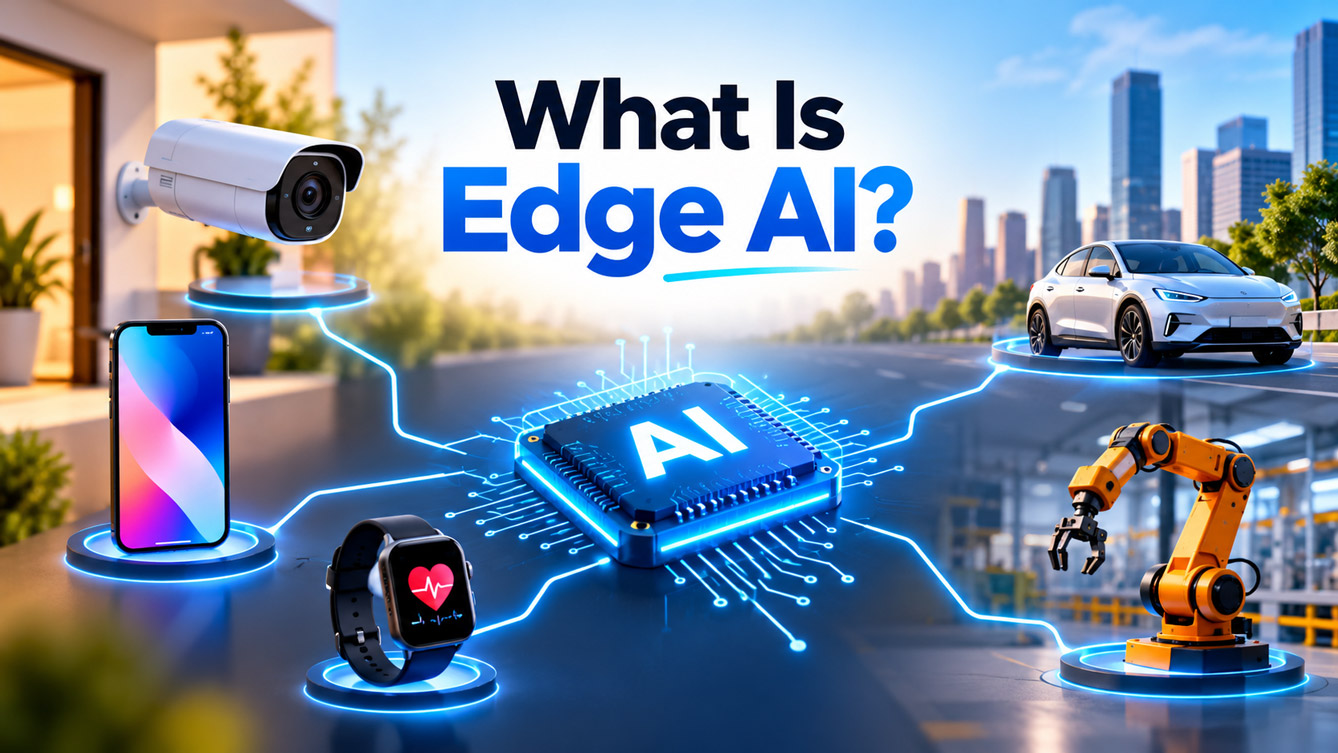
Imagine a security camera that recognises a stranger and alerts you instantly, a smartwatch that detects an unusual heartbeat, or a car that reacts to danger within milliseconds.
Now imagine these devices making intelligent decisions without sending every piece of information to a distant computer. Sounds impressive, right?
This is the power of Edge AI, a technology that brings artificial intelligence closer to where we actually use it. From smartphones and smart homes to hospitals, factories, and self-driving cars, Edge AI is changing how machines think and respond.
But what exactly is Edge AI?
How does it work, and why are technology companies investing so much in it? Let’s explore this fascinating technology in simple English.
What Is Edge AI?
Edge AI stands for Edge Artificial Intelligence. It combines artificial intelligence with devices that process information near the place where that information originates. In simple terms, Edge AI allows devices to analyse data and make intelligent decisions locally instead of depending entirely on the internet or a distant cloud server.
Think about your smartphone. It can recognise your face, improve your photographs, and understand your voice. Depending on your device and the feature, it may perform some of these tasks directly on the phone. That is a practical example of Edge AI.
Traditionally, many AI applications send information to powerful computers in data centres for processing. Edge AI changes this approach by bringing some of that intelligence directly to smartphones, cameras, vehicles, machines, and other connected devices.
The result? Faster responses, less dependence on internet connectivity, and potentially better privacy. Most importantly, Edge AI helps everyday devices become more intelligent without requiring them to send every request to the cloud.
What Does the Word “Edge” Mean in Edge AI?
Have you ever wondered why technology experts use the word “edge”? It does not refer to the physical edge of a device or a computer screen.
In computing, the edge refers to the place where data originates or where devices operate. This could be a smartphone in your hand, a camera outside a building, a sensor inside a factory, or a computer inside a vehicle.
Imagine a factory machine that produces thousands of readings every minute. Instead of sending every reading to a distant server, the machine can use a nearby computing device to identify unusual activity. It can then alert the operator immediately.
Here, the machine or nearby computer acts as the edge. When it uses artificial intelligence to analyse information locally, we call it Edge AI.
In other words, Edge AI brings intelligence closer to the action. Rather than always asking a distant computer for answers, a device can analyse its surroundings and respond on its own.
How Does Edge AI Work?
You do not need a computer science degree to understand how Edge AI works. The process becomes easy when we break it into a few simple steps.
First, a device collects information through a camera, microphone, sensor, or another input source. For example, a smart security camera captures images of people entering a building.
Next, an AI model examines the information. The model acts like a trained brain that recognises patterns and identifies what the information means. It might distinguish a person from a passing vehicle or a moving tree branch.
Finally, the device takes an appropriate action. It might send an alert, activate an alarm, or save a particular recording.
Consider a smart doorbell. It captures a visitor’s image, checks whether the image contains a person, and sends a notification to your phone. If the device performs this recognition locally, it can respond without sending every image to a cloud server.
However, Edge AI does not mean that every operation happens entirely offline. Some devices still use cloud services for updates, advanced analysis, storage, or additional features.
Edge AI vs Cloud AI: What Is the Difference?
To understand Edge AI better, let’s compare it with Cloud AI, another important technology behind modern artificial intelligence.
Cloud AI uses powerful computers in remote data centres to process information. Users send requests over a network, and those computers return the results. Many online AI assistants and large-scale AI services rely on cloud computing.
Edge AI, on the other hand, processes information on or near the device that collects it. A smartphone might recognise an object directly, while a factory sensor might use a nearby computer to identify equipment problems.
Here is a simple example. Suppose you ask your phone to recognise a flower in a photograph. With Edge AI, your phone can analyse the image locally if it has a suitable AI model. With Cloud AI, your phone may upload the image to a remote server for analysis.
Neither approach wins in every situation. Edge AI works well when speed, offline operation, or local data processing matters. Cloud AI works well when an application needs substantial computing power, large shared datasets, or complex AI models.
Many modern systems combine both approaches. They use Edge AI for immediate decisions and cloud computing for tasks that require more resources.
Why Is Edge AI Becoming So Important?
Why are technology companies bringing AI directly into devices when cloud computing already works so well? The answer lies in five major benefits.
1. Faster Responses
Speed matters whenever a device must react immediately. Imagine a car detecting an obstacle on the road. Even a short delay can matter when the vehicle needs to respond.
Edge AI can analyse information locally and reduce the time spent sending data to a remote server and waiting for a response. Technology experts call this delay latency.
Lower latency helps smart cameras, industrial robots, medical monitoring devices, and driver-assistance systems respond quickly. However, the actual response time depends on the hardware, software, network, and AI model.
2. Better Privacy
Would you feel comfortable sending every conversation, personal photograph, or video recording to an online server? Many people would prefer to keep such information on their own devices.
Edge AI can help protect privacy by processing sensitive information locally. For example, a device might recognise a voice command without uploading the complete audio recording.
Nevertheless, local processing does not automatically guarantee complete privacy. Apps can still transmit other information, so users should check privacy settings and data-sharing policies.
3. Less Dependence on the Internet
What happens when your internet connection suddenly stops working? Cloud-dependent applications may lose some or all of their functionality.
Edge AI can help devices continue performing certain intelligent tasks even without an active internet connection. An offline voice command, for example, might still work if the device contains the required model and software.
This capability becomes especially useful in remote locations, industrial facilities, vehicles, and areas with unreliable connectivity.
4. Lower Data Transfer Costs
Sending enormous amounts of information across a network can consume bandwidth and increase operating costs.
Imagine a factory with hundreds of cameras that continuously record production lines. Instead of uploading every frame, local AI systems can identify important events and transmit only relevant clips or alerts.
This approach reduces unnecessary data transfers. However, the savings depend on how much information the system filters and how frequently it communicates with other systems.
5. Greater Efficiency at Scale
Businesses often operate thousands of connected devices across different locations. Sending every measurement to a central server can create unnecessary network traffic and processing demands.
Edge AI distributes some of the workload across local devices. As a result, organisations can process information closer to their operations and reserve central computing resources for more demanding tasks.
This makes Edge AI particularly attractive for large factories, retail chains, transport networks, and smart cities.
Where Is Edge AI Used in the Real World?
Edge AI is not just a technology for the future. It already supports many everyday features and business applications. Let’s look at some interesting examples.
1. Smartphones and Personal Devices
Your smartphone may use AI to recognise faces, improve photographs, remove unwanted background noise, or understand voice commands.
Some devices also support on-device writing assistance, language processing, image generation, and other AI features. The exact capabilities depend on the phone’s hardware, operating system, and software.
For example, a camera can identify a face and adjust focus or exposure to capture a better photograph. When the device performs the relevant AI processing locally, it demonstrates Edge AI in action.
As phone manufacturers introduce more powerful processors, they can run increasingly capable AI models directly on mobile devices.
2. Smart Homes and Security Cameras
Imagine your security camera notifying you only when someone approaches your front door instead of alerting you whenever a tree moves in the wind.
Edge AI can help cameras distinguish people, animals, vehicles, and other objects. Smart doorbells can also identify certain events and trigger relevant notifications.
In a smart home, local AI may help automate lighting, recognise familiar voice commands, or detect unusual activity. Some systems can continue operating when the internet goes down, provided their local features do not depend on cloud services.
These capabilities can make smart homes more responsive and reduce unnecessary alerts.
3. Healthcare and Wearable Devices
Could a small device on your wrist help you understand what is happening inside your body? Modern wearables already track several health-related measurements, and AI can help analyse patterns in some of these readings.
For example, a smartwatch may use local processing to identify certain patterns in heart-rate data or detect a possible fall. Some devices also provide irregular-heart-rhythm notifications under specific conditions.
Edge AI can support quicker analysis and limit the need to transfer raw data. However, not every wearable feature uses Edge AI, and a device notification does not replace a medical diagnosis.
In hospitals, local AI systems can also help process medical images, monitor equipment, and analyse sensor readings. Healthcare professionals must still consider accuracy, patient safety, and applicable regulations.
4. Self-Driving Cars and Driver Assistance
A vehicle needs to understand its surroundings while moving. It may use cameras, radar, and other sensors to identify pedestrians, nearby vehicles, road markings, and potential obstacles.
Edge AI can help the vehicle analyse this information locally and support decisions within driver-assistance systems.
For example, an AI system may identify a vehicle approaching too quickly and help trigger a collision warning. Other systems can assist with lane detection or automatic emergency braking.
These applications demand fast and reliable processing. However, driver-assistance features vary widely, and drivers must understand their limitations. Edge AI alone does not make a vehicle fully autonomous or guarantee safe driving.
5. Smart Factories and Industrial Machines
Factories can lose significant time and money when essential equipment fails unexpectedly. What if a machine could identify warning signs before a breakdown occurs?
Edge AI can analyse vibration, temperature, pressure, and other sensor readings to identify unusual patterns. The system can alert maintenance teams when equipment shows signs of possible trouble.
For example, a motor that vibrates differently from normal may indicate wear or another developing problem. A local AI system can flag the change before the motor stops working.
This approach supports predictive maintenance, helps reduce unexpected downtime, and can improve factory efficiency. Still, the results depend on sensor quality, model accuracy, and appropriate maintenance practices.
6. Retail Stores and Shopping
Have you ever wondered how shops can manage shelves, queues, and inventory more efficiently? Edge AI can help retailers analyse store activity using cameras, sensors, and local computing systems.
For example, a smart shelf system might detect when products run low. Another system could estimate queue lengths and alert employees when more checkout counters need attention.
Retailers can also use computer vision to identify misplaced products or monitor certain store conditions. Depending on the system design, local processing may reduce the need to transfer video recordings to external servers.
Businesses must still respect privacy laws and explain how they collect and use customer information.
7. Agriculture and Smart Farming
Farmers often need to make decisions quickly when crops face pests, diseases, or changing weather conditions. Edge AI can help analyse information from cameras, soil sensors, and agricultural equipment.
For example, a camera attached to a farming machine may identify weeds and help guide targeted spraying. A local system may also analyse soil moisture readings and support irrigation decisions.
These applications can help farmers use water, fertilisers, and other resources more efficiently. In remote agricultural areas, local processing can also reduce dependence on a constant internet connection.
What Is the Difference Between Edge AI and IoT?
You may have heard another technology term called the Internet of Things, or IoT. Although Edge AI and IoT often work together, they serve different purposes.
IoT connects physical devices to networks so they can collect, exchange, and sometimes act on information. Examples include smart bulbs, connected thermostats, industrial sensors, and smart electricity meters.
Edge AI adds artificial intelligence to devices or nearby computing systems. It helps them analyse collected information, recognise patterns, and make intelligent decisions.
Imagine a connected temperature sensor inside a factory. The IoT system collects temperature readings and sends them to another system. If Edge AI analyses those readings and identifies signs of overheating, it adds intelligence to the process.
In simple terms, IoT helps devices communicate, while Edge AI helps devices understand information and respond intelligently. Together, they can create more useful and efficient connected systems.
Edge AI vs Generative AI: Are They the Same?
Here is another common question. Are Edge AI and Generative AI the same thing?
Not exactly. Generative AI creates new content, such as text, images, audio, or video. Edge AI describes where AI processing happens, namely on or near the device that generates the data.
These concepts can work together. For example, a smartphone might run a small generative AI model locally to summarise a note or help rewrite a message.
However, some generative AI models require more computing power than a mobile device can comfortably provide. In those cases, the application may use cloud processing or a combination of local and cloud resources.
Therefore, Generative AI describes a type of AI capability, while Edge AI describes an approach to deploying AI. A system can use both technologies at the same time.
What Are the Main Challenges of Edge AI?
Edge AI offers impressive benefits, but it also comes with practical challenges. Understanding these limitations helps us see where the technology works best.
Limited Computing Power
A smartphone, camera, or small sensor cannot match the computing resources of a large data centre. Developers must choose AI models that fit the device’s processing power, memory, and energy limits.
They often optimise models to reduce their size and improve speed. However, smaller models may struggle with some complex tasks.
Battery and Energy Consumption
Running AI models requires energy. A device that continuously analyses images, audio, or sensor readings may consume more battery power than one that performs simpler tasks.
Developers must balance speed, accuracy, and energy use to create practical products. This challenge matters especially for battery-powered cameras, wearables, and remote sensors.
Security Risks
Edge AI can improve privacy, but connected devices can still face cyberattacks. Attackers may target outdated software, weak passwords, exposed network connections, or poorly protected devices.
Organisations need secure updates, access controls, encryption, and regular monitoring. They should also protect AI models and the information those models use.
Updating and Managing Devices
Imagine managing ten thousand smart devices across different locations. Updating their software, fixing problems, and checking their performance can become complicated.
Businesses need reliable systems to deploy updates, monitor device health, and manage different hardware versions. Without proper management, devices may run outdated models or produce inconsistent results.
Accuracy and Reliability
AI systems can make mistakes. A security camera might misidentify an object, while an industrial system might overlook an unusual equipment pattern.
Developers must test models under realistic conditions, monitor their performance, and plan for situations where the AI cannot make a confident decision. In safety-critical applications, human oversight and backup systems remain essential.
What Is the Future of Edge AI?
The future of Edge AI looks promising because devices continue to gain computing power while AI models become more efficient.
Smartphones may handle more personal AI tasks locally. Wearable devices may analyse selected signals more efficiently. Factories may use intelligent machines that detect problems earlier, while vehicles may process increasingly complex information from their surroundings.
Another important development is the growth of hybrid AI systems. These systems combine edge devices with cloud computing instead of relying exclusively on either approach.
For instance, a device might handle simple decisions locally and send complex requests to a cloud service. This combination can offer a practical balance between speed, computing power, cost, and privacy.
At the same time, developers must address energy consumption, security, model accuracy, and responsible data use. The success of Edge AI will depend not only on smarter technology but also on how carefully companies design and manage it.
Will Edge AI Change Our Daily Lives?
Think about how quickly smartphones, smartwatches, and connected home devices have become part of everyday life. Edge AI could make these devices even more useful by helping them understand situations and respond without waiting for distant servers.
Your phone might offer more private assistance, your home security system might detect important events faster, and industrial machines might identify problems before they cause costly interruptions.
Yet, the biggest change may happen quietly. We may not even notice when a device uses AI locally because the technology simply makes it work faster and more naturally.
Edge AI is not about making every device intelligent for the sake of it. It is about giving devices the right intelligence, at the right place, and at the right time.
Final Thoughts: The Future of AI May Be Closer Than You Think
Artificial intelligence once seemed like something that belonged mainly in research laboratories and powerful computers. Today, it increasingly runs on the devices we carry, the machines we use, and the systems that support our daily lives.
Edge AI brings this intelligence closer to us. It can help devices respond faster, reduce unnecessary data transfers, support offline operation, and improve privacy when developers design systems carefully.
Of course, it will not replace cloud computing completely. Instead, both technologies will continue to work together, each handling the tasks it performs best. The real opportunity lies in building technology that feels faster, smarter, safer, and more helpful.
Now, here is a question for you: If your smartphone could use Edge AI to perform one task faster, more privately, or without the internet, what would you want it to do? Share your thoughts with friends, family, or colleagues who enjoy technology. You might be surprised by how many everyday devices already use this approach. And if this article helped you understand Edge AI, share it with someone who still thinks artificial intelligence only lives in the cloud!
Frequently Asked Questions About Edge AI
1. What is Edge AI in simple words?
Edge AI is a technology that allows devices to process information and make intelligent decisions locally, rather than depending entirely on remote cloud servers. Examples include smartphones that recognise faces and cameras that identify people.
2. What is the difference between Edge AI and Cloud AI?
Edge AI processes information on or near the device that collects it. Cloud AI sends information to remote servers for processing. Edge AI can reduce response times and data transfers, while Cloud AI can provide access to greater computing power.
3. What are some examples of Edge AI?
Common examples include smartphone image recognition, smart security cameras, certain smartwatch features, industrial equipment monitoring, driver-assistance systems, and smart farming devices. The exact AI processing location depends on the product.
4. Does Edge AI work without the internet?
Yes, Edge AI can work without the internet when a device has the necessary AI model, software, and computing resources installed locally. However, features that depend on online services, cloud data, or remote updates may still require connectivity.
5. Is Edge AI the future of artificial intelligence?
Edge AI will likely play an important role in the future of AI because it supports fast local processing and can reduce unnecessary data transfers. However, cloud computing will remain important for demanding tasks. Many future systems will combine both approaches.