

To Understand Does ChatGPT Search Google for Every Answer?
First You need to understand the basics of How chatGTP works, Once you understand this, then you will have answer for your question.
How Does ChatGPT Actually Work?
Have you ever wondered what really happens when you type a question into ChatGPT and receive an answer within seconds? It can explain a difficult topic, write an email, create code, summarize a long document, or even help you brainstorm an idea. But does ChatGPT actually “think” like a human? Does it search the internet every time you ask something? And how can a machine produce sentences that sound so natural? The answer becomes surprisingly interesting when we look behind the screen.
What Exactly Is ChatGPT?
Let us start with the most basic question. What exactly is ChatGPT?
ChatGPT is an artificial intelligence system that can understand and generate human-like text. OpenAI developed ChatGPT using a type of AI model called a large language model, or LLM.
The name may sound complicated, but the basic idea feels much simpler. ChatGPT learns patterns from huge amounts of text and uses those patterns to produce useful responses.
Think about how you learn a language. You read books, listen to people, study sentences, and notice how words work together. Over time, you learn which words usually appear together.
ChatGPT follows a similar learning idea, but on a vastly larger scale.
Does ChatGPT Actually Understand What We Say?
This question gets interesting very quickly.
When you type, “Explain gravity to a child,” ChatGPT does not understand gravity in exactly the same way a human teacher does. Instead, the model processes your words and identifies patterns that help it produce an appropriate response.
It can recognize that “explain,” “gravity,” and “child” create a particular type of request. As a result, it can generate an explanation using simple language.
So, should we call that understanding?
In everyday conversation, we often say that ChatGPT understands us because it responds appropriately. Technically, however, the model works through patterns, probabilities, and mathematical calculations rather than human awareness.
That difference matters.
The Secret Behind ChatGPT: Language Models
Have you ever used your phone’s keyboard and noticed that it suggests the next word?
Suppose you type, “I am going to the.” Your phone might suggest “market,” “office,” or “school.”
A language model works with a similar basic concept, but at an enormous level.
ChatGPT analyzes the words in your conversation and predicts what text should come next. However, modern language models do far more than simple word prediction.
They learn relationships between words, phrases, ideas, writing styles, and contexts. This ability allows them to produce complete answers instead of random collections of words.
That prediction process forms one of the most important foundations of ChatGPT.
How Does ChatGPT Learn?
Now comes another important question. How can ChatGPT learn so much?
During training, developers expose the model to a huge collection of text. The training material can include books, articles, websites, documents, and other sources, depending on the particular model and its training process.
The model does not simply read those materials like a person reading a book.
Instead, it processes enormous numbers of examples and adjusts internal mathematical values called parameters. These parameters help the model recognize patterns in language.
Imagine learning millions of examples such as:
“India is a country in…”
“Photosynthesis allows plants to…”
“The capital of France is…”
The model gradually learns relationships between words and concepts from such examples.
It does not memorize the world like a traditional database. Instead, training helps it build a complex mathematical representation of language patterns.
What Are Parameters?
The word “parameters” may sound intimidating. So, let us make it simple.
Think of parameters as tiny adjustable settings inside the AI model. During training, the system adjusts these settings repeatedly.
Imagine tuning a huge musical instrument with millions or billions of tiny controls. Each adjustment changes how the instrument responds.
Similarly, the model adjusts its parameters to become better at predicting useful language.
Large AI models can contain billions of parameters. These parameters help the model recognize complicated relationships between different pieces of information.
However, more parameters do not automatically guarantee perfect answers. Training quality, model design, data quality, and other factors also matter.
What Happens When You Ask ChatGPT a Question?
Here is where the process becomes fascinating.
Imagine you type:
“Why does the sky look blue?”
What happens next?
First, ChatGPT receives your message. The system processes the text and breaks it into smaller pieces that the model can work with.
These pieces are called tokens.
A token may represent a whole word, part of a word, punctuation, or another small piece of text. The exact tokenization depends on the model.
For example, a sentence such as “How are you?” becomes a sequence of smaller units that the model can process mathematically.
The model then examines the relationship between those tokens and the surrounding context.
Finally, it generates a response one piece at a time.
What Are Tokens?
You might now be asking, “Why doesn’t ChatGPT simply process complete words?”
Computers work extremely well with numbers. Therefore, AI models convert text into numerical representations that they can process mathematically.
Tokens provide a practical bridge between human language and machine calculations.
For example, a long word might become several tokens. A short common word might use one token. Punctuation can also become a token.
The model works with these tokens rather than treating language exactly like humans do.
This process helps ChatGPT handle enormous amounts of text efficiently.
What Is the Transformer?
Now we reach one of the most important technologies behind modern language models.
Have you heard the word Transformer in discussions about AI?
A Transformer represents a type of neural network architecture that changed the way machines process language.
Researchers introduced the Transformer architecture in a 2017 research paper. It brought a powerful approach called attention to language processing.
The name “Transformer” might sound dramatic, but its purpose makes sense.
The architecture helps the model examine relationships between different parts of a sentence. This ability helps ChatGPT consider context instead of looking at each word separately.
What Does “Attention” Mean in AI?
Consider this sentence:
“Ravi gave Arun his book because he had finished reading it.”
Who does “he” refer to?
A human reader can use context to work out the likely meaning. AI models need a way to examine relationships between words.
The Transformer uses an attention mechanism to help the model determine which parts of the input matter more for the current task.
You can think of attention like a highlighter.
When you read a paragraph, you do not give every word equal importance. Instead, you focus on the words that help you understand the meaning.
Attention gives the model a mathematical way to focus on important relationships.
Does ChatGPT Search Google for Every Answer?
Here is a common misconception.
Does ChatGPT automatically search Google every time you ask a question?
No, not necessarily.
A language model can generate an answer using what it learned during training and the information available in the current conversation. Some ChatGPT experiences also provide web access or other tools when appropriate.
Without such a tool, the model does not magically browse the entire internet whenever you ask a question.
This distinction becomes especially important when you ask about today’s news, current prices, recent events, or other changing information.
Why Does ChatGPT Sometimes Give a Wrong Answer?
If ChatGPT can process so much information, why does it sometimes make mistakes?
This happens because ChatGPT generates responses based on learned patterns. It does not possess perfect knowledge or human-like judgment.
Sometimes the model produces an answer that sounds extremely confident but contains incorrect information. People often call this a hallucination.
The word sounds strange, but the idea remains simple. The model generates text that fits the pattern of the conversation even when the information lacks accuracy.
That means you should not blindly trust every answer.
For important topics, always verify critical information using reliable sources.
Why Does ChatGPT Sound So Human?
Have you noticed how ChatGPT can change its writing style?
You can ask it to write formally, casually, humorously, professionally, or in simple English.
How does it do that?
During training, the model learns patterns from many different styles of writing. It learns how different words and sentence structures appear in different contexts.
When you ask for a particular style, your instruction gives the model a direction.
The model then predicts text that matches that instruction and the surrounding conversation.
That ability makes ChatGPT feel much more natural than older computer programs.
Does ChatGPT Have Feelings?
This question often creates confusion.
ChatGPT can write, “I am happy to help,” or “I understand how you feel.” However, those sentences do not mean that ChatGPT experiences emotions like a human.
The model generates language based on patterns and instructions.
It does not have human feelings, personal experiences, or consciousness simply because it can discuss emotions.
Therefore, a friendly response does not prove that a machine feels friendship.
It shows that the system can generate language that humans recognize as friendly.
How Does ChatGPT Remember a Conversation?
You may have noticed something interesting.
You ask a question, and then you ask a follow-up question without repeating everything. ChatGPT can often understand what you mean.
How does that happen?
The system can use the conversation context available to it. Earlier messages provide information that helps the model interpret your latest message.
For example, if you ask:
“What is photosynthesis?”
Then you ask:
“Can you explain it to a child?”
The second question makes sense because the earlier conversation provides the missing context.
However, context has limits. Very long conversations can introduce complexity, and different ChatGPT features can handle memory and conversation history in different ways.
Why Can ChatGPT Write Code?
ChatGPT does not only work with normal sentences.
It can also generate programming languages such as Python, JavaScript, PHP, HTML, CSS, and many others.
Why?
Because programming code also contains patterns.
During training, language models can learn patterns found in code and technical documentation. They can therefore generate code that follows common programming structures.
However, generated code can still contain bugs or security problems.
A developer should test and review AI-generated code before using it in a real project.
Is ChatGPT Like a Search Engine?
Not exactly.
A search engine primarily helps you find existing information from websites and other sources. ChatGPT primarily generates a response based on its model and the context available to it.
That difference creates two very different experiences.
A search engine might give you ten links and ask you to explore them. ChatGPT can explain a concept directly in a conversational format.
However, these systems can work together when ChatGPT has access to web-search capabilities.
That combination can make AI assistants much more useful for current information.
Why Does ChatGPT Need So Much Computing Power?
You might wonder why companies need powerful computers to operate AI models.
The reason comes down to scale.
Large language models contain enormous numbers of parameters. Processing those parameters requires significant computing resources.
Specialized chips called GPUs and other AI accelerators can perform many mathematical operations efficiently.
When millions of people use an AI service, the system must process huge numbers of requests at the same time.
Therefore, AI companies need large data centers filled with powerful computing hardware.
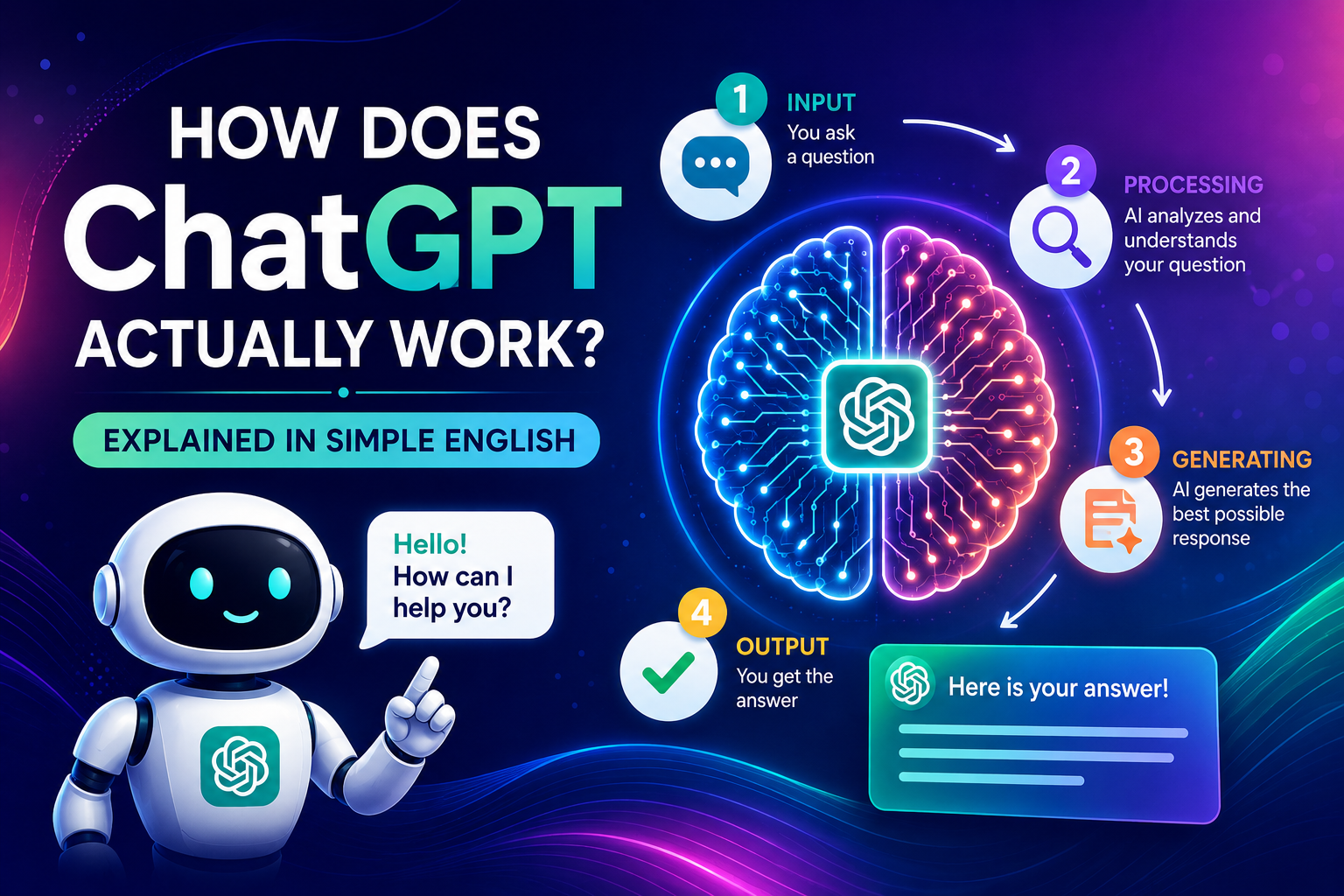
What Happens When ChatGPT Generates an Answer?
Let’s put everything together.
You type a question. The system processes your text and converts it into tokens.
The model examines those tokens and the surrounding context. Its neural network performs large numbers of mathematical calculations.
Then the model predicts a likely next token.
It adds that token to the response and predicts another one.
This process continues rapidly until the system completes the answer.
So, when you see ChatGPT produce a paragraph almost instantly, the system has actually performed a huge number of calculations behind the scenes.
Is ChatGPT Intelligent?
This question deserves a careful answer.
ChatGPT clearly demonstrates abilities that we normally associate with intelligence. It can explain ideas, summarize information, solve many problems, write creatively, and help with programming.
However, its intelligence does not work exactly like human intelligence.
Humans learn through physical experiences, emotions, social relationships, observation, and many other forms of interaction.
ChatGPT mainly works through computational models that process information and generate predictions.
So perhaps the better question is not “Is ChatGPT intelligent?”
Instead, ask this:
What kind of intelligence can a machine develop through language and computation?
That question opens the door to a much bigger conversation about the future of AI.
Will ChatGPT Replace Humans?
This question probably crosses your mind whenever you see AI perform impressive tasks.
The answer is not as simple as yes or no.
AI can automate repetitive work and assist people with writing, coding, research, customer support, design, and many other tasks.
At the same time, humans still provide judgment, responsibility, creativity, emotional understanding, real-world experience, and decision-making.
The most powerful approach may not involve humans competing against AI.
Instead, humans can learn how to work effectively with AI.
The people who understand both the strengths and limitations of AI may gain a significant advantage.
The Most Important Thing to Remember
ChatGPT may look like a person sitting behind a computer screen and answering your questions. In reality, a sophisticated mathematical system performs enormous amounts of computation behind every response.
It learns patterns from training data. It processes tokens. Transformer networks help it examine context. Attention helps it focus on important relationships. Finally, the model generates a response piece by piece.
Once you understand these basic ideas, ChatGPT no longer feels like magic.
And perhaps that makes it even more fascinating.
Frequently Asked Questions About ChatGPT
1. What is ChatGPT in simple words?
ChatGPT is an AI system that generates human-like text. It processes your instructions and uses patterns learned during training to produce a relevant response.
2. Does ChatGPT understand language like humans?
Not in exactly the same way. ChatGPT processes language using mathematical patterns and relationships. It can produce remarkably useful responses, but that does not mean it experiences human understanding.
3. Does ChatGPT always give correct answers?
No. ChatGPT can sometimes generate incorrect information. Therefore, you should verify important facts, especially for medical, legal, financial, technical, and other high-stakes decisions.
4. What is a Large Language Model?
A Large Language Model, or LLM, is an AI model trained on large amounts of text. It learns language patterns and uses those patterns to generate and process text.
5. What is the Transformer in ChatGPT?
A Transformer is a neural network architecture that helps AI models process relationships between different parts of language. Its attention mechanism plays an important role in understanding context.
Final Thoughts: Now You Know What Happens Behind the Chat Box
The next time you type a question into ChatGPT, pause for a second and think about what happens behind that simple chat box. Your words become tokens, the model processes relationships, countless mathematical calculations happen in the background, and the system generates an answer one piece at a time. It may look effortless, but an extraordinary amount of technology works behind those few seconds.
Now that you know how ChatGPT actually works, there is one question worth asking yourself: If today’s AI can already understand our language, write our code, and help us solve problems, what will the next generation of AI be able to do? If you found this explanation interesting, why not share it with someone who uses ChatGPT every day but has never wondered what happens behind the screen?
SEO Details
Focus Keyphrase: How Does ChatGPT Work
SEO Title: How Does ChatGPT Actually Work? A Simple Explanation
Slug: how-does-chatgpt-work-simple-explanation
Meta Description: Learn how ChatGPT works in simple English, from tokens and training to Transformers, AI predictions, and why ChatGPT sometimes makes mistakes.
Suggested Secondary Keywords:
- How ChatGPT works
- How does ChatGPT work
- What is ChatGPT
- How ChatGPT generates answers
- How AI language models work
- What is a Large Language Model
- What is a Transformer in AI
- How ChatGPT understands questions
- How artificial intelligence works