

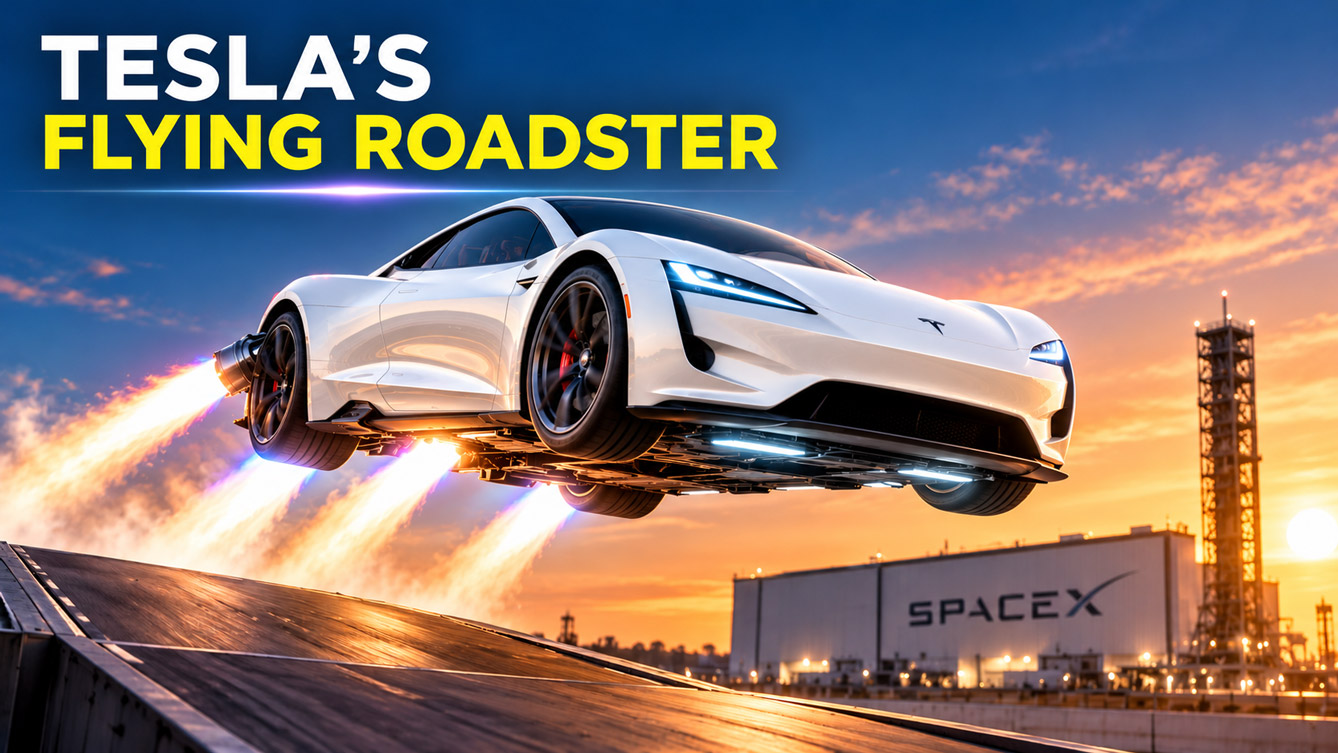
Imagine driving a sports car that can accelerate faster than a racing car, stick to a wall like a superhero, and even jump over other vehicles without touching them! Sounds like something straight out of a science-fiction movie, doesn’t it? But what if a car could use technology from a real rocket company to make some of these incredible ideas possible? Tesla’s new Roadster concept brings this exciting possibility closer to reality. With rocket-powered air thrusters, a powerful suction fan, and technology developed with help from SpaceX engineers, this electric sports car could change the way we think about speed, grip, and performance. However, one big question remains: can a car really fly, and what happens when rocket science meets the road?
What Makes Tesla’s New Roadster So Special?
Most sports cars compete by improving their engines, batteries, aerodynamics, and tyres. Tesla wants to take a different route by combining electric vehicle technology with ideas borrowed from the space industry. The company demonstrated its Roadster concept at a SpaceX rocket testing facility near Waco, Texas. The presentation included some spectacular stunts that attracted attention from car enthusiasts and technology fans.
During the demonstration, Tesla showed the car climbing a curved ramp and remaining attached to the surface before launching away. Another demonstration showed the vehicle rising over several other Tesla vehicles. These scenes looked almost impossible, but they introduced two important technologies: air thrusters and a suction fan.
Tesla also presented a video claiming that the Roadster could accelerate from zero to 60 miles per hour in less than one second. That speed would put it in extraordinary territory. However, readers should remember that these figures represent Tesla’s claims, not independently verified production-car performance. The company has indicated that production could begin in 2028, so the final vehicle and its capabilities may still change.
How Can a Car Fly Using Rocket Technology?
Have you ever released an inflated balloon without tying its opening? The balloon suddenly shoots in one direction while air escapes in the opposite direction. Tesla’s rocket-assisted Roadster uses a similar principle, although its system relies on carefully controlled equipment rather than a loose balloon.
The car uses devices called cold-gas thrusters. These devices store gas under high pressure and release it through small openings called nozzles. As the gas rushes outward, it creates a force that pushes the vehicle in the opposite direction. Engineers call this effect thrust.
Unlike a traditional rocket engine, a cold-gas thruster does not burn fuel to produce its jet. Instead, it releases previously compressed gas. This makes the system simpler than a combustion-based rocket engine, although it also limits the amount of force it can generate from a given quantity of stored gas.
NASA has used similar technology on small spacecraft. Satellites need to turn, adjust their direction, and maintain their orientation in space. Cold-gas thrusters help them perform these movements.
Tesla wants to use the same basic principle for a much more unusual purpose: helping a car accelerate rapidly and potentially lift off the ground for brief moments.
What Exactly Are Air Thrusters, and How Do They Work?
Think of an air thruster as a powerful, controllable balloon built into a vehicle. Instead of allowing air to escape freely, the system uses a pressurised tank, valves, and nozzles to direct the escaping gas.
When the driver requests additional thrust, electric actuators operate the valves. These actuators use electric motors to control the opening and closing process. The system can make rapid adjustments to regulate the direction and amount of thrust.
According to reports from the demonstration, Tesla engineering executive Lars Moravy described a setup with ten thrusters and a large compressed-air supply. Tesla has also described an electric compressor that replenishes the air supply while the car drives.
However, compressed air is not unlimited energy. Every time the system fires, it consumes some of its stored supply. The car must therefore balance acceleration, lifting, steering adjustments, and braking against the amount of air remaining in its tank.
That limitation makes the technology exciting but also challenging. The Roadster cannot keep firing its thrusters indefinitely. Engineers must carefully manage every burst of thrust to achieve the desired result.
How Long Can Tesla’s Roadster Stay in the Air?
Here is a question that naturally comes to mind: if the Roadster can lift itself off the ground, can it fly around like a helicopter?
Not with the technology Tesla has described. A cold-gas thruster releases a limited supply of compressed gas, and lifting a heavy car requires a tremendous amount of force. The Roadster’s proposed system therefore points towards short jumps rather than sustained flight.
Consider a simple example. Imagine trying to hold a heavy suitcase above your head. You can manage it for a short time, but the heavier the suitcase becomes, the more effort you need. A rocket-assisted car faces a similar problem, except that its lifting force comes from escaping gas.
A typical car weighs far more than a small satellite. Consequently, the thrusters must generate much more force to lift the vehicle than satellite thrusters normally provide.
The car also needs thrust for other movements. Accelerating forward, controlling its position, performing a flip, and slowing down before landing all consume stored gas. Every additional movement reduces the time available for lifting.
For these reasons, any airborne demonstration should not be confused with the ability to fly over long distances. The proposed system aims to deliver dramatic, short-duration movements rather than replace an aircraft or helicopter.
How Can the Roadster Reach 60 mph in Less Than One Second?
Now comes one of the most unbelievable claims. Tesla has presented the Roadster as capable of accelerating from zero to 60 mph in less than a second. That is approximately zero to 97 kilometres per hour in under one second.
How could an electric car accelerate so quickly when even powerful sports cars struggle to achieve such times?
The secret lies in the difference between tyre grip and rocket thrust.
An ordinary car transfers engine power to its wheels. The tyres push against the road, and the road pushes the car forward. However, the tyres can only provide a limited amount of grip before they start slipping. Once the wheels lose traction, adding more engine power does not necessarily produce more forward acceleration.
Rocket thrusters offer another way to generate force. They push gas backwards, which produces a forward force on the car. Because this force does not depend on the tyres gripping the road, it can supplement the acceleration that the wheels provide.
Imagine pushing a shopping trolley while another person pulls it forward with a rope. The trolley receives force from two different sources. In a simplified way, Tesla’s concept combines the forward push from its wheels with additional force from its air thrusters.
Nevertheless, extremely rapid acceleration creates other challenges. The vehicle must manage its stability, protect its occupants, control its structure, and stop safely. Tesla’s claimed acceleration figure will need independent testing under clearly defined conditions before anyone can treat it as a proven production-car result.
What Is Downforce, and Why Does It Matter?
Speed alone does not make a sports car impressive. A car must also turn safely, brake effectively, and maintain contact with the road. This is where another unusual part of Tesla’s Roadster becomes important: its suction fan.
Have you ever noticed how racing cars have large wings at the front or rear? These wings help press the car towards the track at high speeds. Engineers call this force downforce.
Downforce increases the load on the tyres, which can help them generate more grip. Better grip can improve cornering and braking, provided the tyres and other components remain within their operating limits.
However, conventional aerodynamic wings depend on moving air. When a racing car travels faster, air flows around its wings and generates downforce. At a standstill, those wings cannot produce the same aerodynamic force.
Tesla’s proposed fan system takes a different approach. It actively removes air from beneath the vehicle, creating lower pressure underneath. The surrounding air pressure then pushes the car towards the surface.
This principle allows a fan-based system to generate downforce even when the vehicle moves slowly or remains stationary. That makes it especially interesting for applications that need grip beyond what ordinary aerodynamic wings can provide.
How Can a Suction Fan Hold a Car Upside Down?
Imagine driving a car up a curved ramp and reaching a point where the vehicle sits upside down. Normally, gravity would pull the car away from the ramp. So how could Tesla keep it attached to the surface?
The answer is the difference in air pressure.
Tesla describes a multi-mode fan and ground-sealing system that draws air from beneath the car. By reducing the pressure underneath, the system creates a force that presses the vehicle against the surface.
Think about a suction cup. When you press a suction cup against a smooth wall and remove the air beneath it, the surrounding atmospheric pressure helps hold it in place. Tesla’s system applies a related principle on a much larger and more complicated scale.
The fan must move enough air to maintain the pressure difference, while the sealing system limits unwanted air leakage around the underside of the vehicle. Without an effective seal, outside air would rush underneath and reduce the suction effect.
This is why the system could potentially help the Roadster remain attached to a suitable surface even when it moves slowly. However, an upside-down demonstration does not mean the car can drive on every ceiling or wall. The surface, sealing conditions, vehicle design, and operating environment all matter.
Why Is Fan Technology Not Completely New?
You might think Tesla invented this technology from scratch. Surprisingly, racing engineers experimented with fan-powered cars decades ago.
One famous example was the Chaparral 2J, which competed in the Can-Am racing series in 1970. Its design used fans to draw air from underneath the car and create additional downforce.
Another well-known example appeared in Formula One. The Brabham BT46B, often called the fan car, won the 1978 Swedish Grand Prix. Its fan-based design generated significant attention, although the car never competed in another Formula One race.
These examples show that engineers have explored active suction for many years. The idea itself is not new, but modern electric motors, electronic controls, materials, and vehicle software could help engineers develop more advanced versions.
Tesla’s approach attempts to combine this established racing concept with an electric sports car and rocket-inspired propulsion. If the company can make the system practical, reliable, and safe, it could demonstrate a new way to improve vehicle performance.
What Does SpaceX Have to Do With Tesla’s Roadster?
Tesla and SpaceX have something important in common: Elon Musk leads both companies. However, their connection goes beyond having the same chief executive.
SpaceX engineers understand how to control spacecraft using small gas jets. Rockets need precise control over their orientation, especially when they travel through space or return towards Earth. Small thrusters can rotate a spacecraft without relying on ordinary steering wheels or road surfaces.
SpaceX’s Falcon launch vehicles use gas-based control systems for certain orientation and manoeuvring tasks. These systems demonstrate how engineers can use carefully directed gas jets to control the movement of a large vehicle.
Tesla’s Roadster applies related engineering ideas in a completely different environment. A spacecraft uses thrusters primarily to control its orientation, while Tesla proposes using thrusters to assist acceleration and potentially lift a road vehicle.
The engineering challenge is considerably different. A car must cope with road bumps, changing traction, passenger comfort, traffic conditions, and strict safety requirements. Therefore, spacecraft technology does not automatically translate into a road-ready vehicle.
Even so, the collaboration could allow Tesla to draw on SpaceX’s experience with high-pressure gas systems, valves, and precision control.
Did Tesla Already Send a Roadster Into Space?
Yes! Tesla and SpaceX have a remarkable connection that began years before the latest Roadster demonstrations.
In February 2018, SpaceX launched its Falcon Heavy rocket for its first demonstration flight. The rocket carried Elon Musk’s personal red Tesla Roadster as a payload. A mannequin dressed in a spacesuit sat in the driver’s seat.
The vehicle travelled into space on a trajectory around the Sun. The launch created one of the most memorable publicity moments in modern spaceflight because it placed an ordinary-looking sports car in an extraordinary setting.
That earlier Roadster did not have to fly using its own engines. The Falcon Heavy rocket carried it into space. The distinction matters because the proposed new Roadster’s thrusters would provide force directly to the car itself.
Tesla has also highlighted special paint and materials inspired by the demands of space technology. Such materials must cope with challenging environmental conditions, although the final vehicle’s precise specifications will determine their actual performance and benefits.
The story therefore comes full circle: SpaceX once carried a Tesla into space, and Tesla now wants to bring rocket-inspired technology into a car.
What Versions of the Roadster Could Buyers Get?
Tesla has discussed different versions of the Roadster, each aimed at a different type of buyer. However, specifications, availability, and pricing could change before production begins.
The Performance version focuses on road use, with active aerodynamics and the proposed fan system. This configuration aims to combine extreme acceleration with improved grip and handling.
The Thrust version adds rear-mounted thrusters intended to improve acceleration beyond the limits of tyre traction. It targets buyers who want the most extreme performance on suitable surfaces.
The Rocket version takes the idea further with a single-seat configuration and ten thrusters positioned around the vehicle. Tesla has described this version as its most ambitious option, with the potential for brief airborne movements.
Reports from the unveiling described reservation payments of $50,000 for the Performance version and $250,000 for the Thrust version. The Rocket version was described as invitation-only, and Tesla had not announced a confirmed final vehicle price in the reported details.
Remember that a reservation does not guarantee a finished vehicle with every demonstrated feature. Production timing, final specifications, safety requirements, and pricing remain important factors for prospective buyers to consider.
Can Tesla Really Turn Science Fiction Into Reality?
The Roadster presents an exciting mix of ideas from electric vehicles, motorsport, and aerospace engineering. Its proposed thrusters could provide force beyond tyre grip, while its suction fan could increase the load on the tyres without depending entirely on vehicle speed.
Yet turning a dramatic demonstration into a dependable production car presents a much bigger challenge. Engineers must manage compressed-air storage, energy consumption, heat, structural loads, passenger safety, and precise electronic controls. They must also ensure that the car behaves predictably in real-world driving conditions.
There is another important distinction: a car that briefly lifts off the ground is not the same as a flying car that can travel through the air safely and repeatedly. Tesla’s proposed technology could enable spectacular short hops, but it does not establish that the Roadster can replace an aircraft.
The real test will come when independent experts evaluate a production-ready vehicle. Until then, the Roadster remains a fascinating example of what happens when automotive engineering borrows ideas from the space industry.
Final Thoughts: The Future of Cars May Be More Exciting Than We Imagine
For decades, car manufacturers have tried to make vehicles faster, safer, and more efficient. Tesla’s Roadster takes that competition into unusual territory by combining electric power, rocket-inspired thrust, and active suction technology. If the company delivers its promises, the result could push the boundaries of what a road car can do.
Still, the most interesting part of this story is not simply whether a car can jump over another vehicle. It is how engineers are challenging familiar limits and finding new ways to solve old problems. Technologies once associated with spacecraft and racing experiments could inspire future developments in vehicle control and performance.
Now imagine a future in which a car can accelerate with rocket-like force and maintain extraordinary grip through advanced suction systems. Would you trust such a car on the road, or would you prefer to watch it from a safe distance? If Tesla’s Roadster delivers even part of what it promises, could it change the future of sports cars? Share this article with a car enthusiast or technology lover and ask them what they think!
Frequently Asked Questions (FAQs)
1. Can Tesla’s Roadster really fly?
Tesla has demonstrated a concept involving rocket-style thrusters and short airborne movements. However, that does not make the Roadster a conventional flying car. Its proposed compressed-gas system would provide limited thrust for brief manoeuvres rather than sustained flight.
2. How do Tesla Roadster’s rocket thrusters work?
The thrusters store gas under high pressure and release it through small nozzles. The escaping gas creates an opposite force that can help propel the vehicle. Unlike conventional rocket engines, cold-gas thrusters do not burn fuel to produce their jet.
3. How can the Tesla Roadster drive upside down?
Tesla proposes using a powerful fan beneath the car to remove air and create lower pressure underneath. The surrounding air pressure then pushes the vehicle towards the surface. The system requires suitable sealing and operating conditions to generate enough downforce.
4. How fast can the Tesla Roadster accelerate from 0 to 60 mph?
Tesla has claimed that the Roadster could accelerate from zero to 60 mph in less than one second with its advanced propulsion system. Independent testing of a production-ready vehicle will be necessary to confirm that performance under clearly defined conditions.
5. When will the new Tesla Roadster be available?
Tesla has indicated that production could begin in 2028. However, production dates, final specifications, pricing, and the availability of individual versions may change. Buyers should check Tesla’s official announcements for the latest confirmed information.