

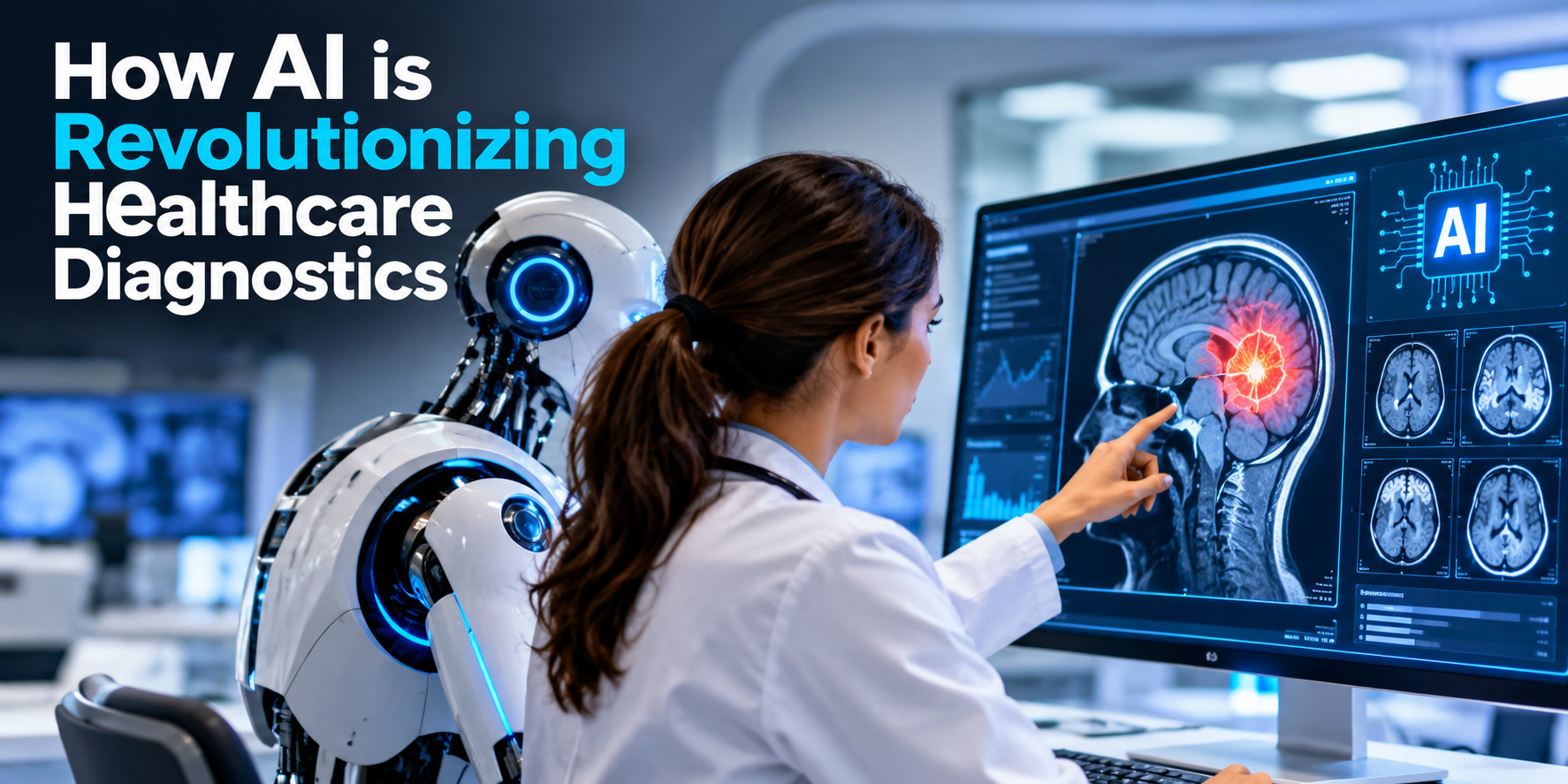
Imagine visiting a hospital, getting a scan, and receiving a warning about a serious health problem before you even notice any symptoms. Now imagine a computer helping the doctor spot that warning in just a few seconds.
This may sound like something from a science-fiction movie. However, artificial intelligence is already changing the way doctors examine medical images, analyze test results, identify diseases, and make important clinical decisions. AI does not replace doctors. Instead, it gives them a powerful digital assistant that can examine huge amounts of medical information quickly and highlight details that might otherwise take much longer to find.
So, what exactly happens when artificial intelligence enters a hospital?
The answer could change the future of healthcare.
What Is AI in Healthcare?
Artificial intelligence, or AI, allows computers to learn patterns from large amounts of information and use those patterns to make predictions or identify problems.
In healthcare, AI can study medical images, laboratory reports, patient information, genetic data, and other clinical information. It can then help doctors identify signs of disease or understand a patient’s condition.
Think about the amount of information a doctor handles every day. A hospital may process thousands of X-rays, CT scans, MRI scans, blood reports, and other medical records.
A doctor must carefully examine each case.
AI can help process this information much faster.
However, AI does not simply look at a medical report and magically announce a diagnosis. Developers train AI systems with large datasets so the systems can recognize specific patterns.
The doctor still plays the most important role. AI simply provides another layer of support.
Why Does Healthcare Need AI?
Have you ever wondered why doctors sometimes need several tests before they can identify a disease?
Many health conditions share similar symptoms. Some diseases also develop silently and show very few warning signs during their early stages.
Doctors often need to combine symptoms, medical history, physical examinations, scans, and laboratory results before reaching a conclusion.
That process requires time and careful attention.
AI can make this process more efficient. It can examine information rapidly and highlight unusual patterns that deserve closer attention.
For example, an AI system can examine thousands of medical images and identify small differences in shape, texture, or structure.
A doctor can then examine the highlighted area more closely.
This combination of human experience and machine analysis can create a stronger diagnostic process.
AI Is Changing Medical Imaging
Medical imaging represents one of the most exciting areas for healthcare AI.
Doctors use X-rays, CT scans, MRI scans, ultrasound images, and other imaging technologies to look inside the human body.
These images can contain extremely small details.
Sometimes, a tiny abnormality can provide an important clue about a disease.
So, how can AI help?
AI models can analyze medical images and search for patterns associated with particular conditions. Depending on the system, AI may help identify tumors, lung abnormalities, fractures, eye diseases, and other conditions.
The technology can also help doctors prioritize cases.
For instance, imagine a hospital receives hundreds of scans during a busy day. An AI system may flag scans that show potentially concerning patterns.
Doctors can then review those cases sooner.
That does not mean AI makes the final decision. Instead, it helps the medical team focus attention where it matters most.
AI and Early Disease Detection
Early detection can make a huge difference in healthcare.
Many diseases become more difficult to manage after they progress. Therefore, doctors constantly look for ways to identify health problems as early as possible.
AI can support that effort.
By analyzing medical images, test results, and other information, AI systems can sometimes identify patterns associated with disease before obvious symptoms appear.
Imagine a patient undergoing a routine medical examination.
The patient feels perfectly healthy.
However, an AI system notices a subtle pattern in an image that deserves further investigation.
The doctor reviews the finding and orders another test.
That additional examination may reveal a problem at an earlier stage.
This example shows why AI could become such an important healthcare tool.
It can help doctors look beyond obvious symptoms and investigate hidden clues.
AI Can Help Detect Cancer
Cancer diagnosis represents another important area of AI research.
Doctors often examine medical images and tissue samples when they investigate cancer. These examinations require significant expertise and attention to detail.
AI can analyze medical images and identify patterns that may indicate abnormal tissue.
Researchers have developed AI systems that assist with different types of cancer detection, including breast cancer, lung cancer, skin cancer, and other diseases.
But here comes an important question.
Can AI detect cancer better than a doctor?
The answer depends on the specific AI system, disease, dataset, and clinical environment. AI performance can vary considerably, so doctors need to evaluate AI results alongside other clinical evidence.
In many situations, the greatest value comes from collaboration.
The AI searches for patterns.
The doctor interprets those findings within the patient’s complete medical story.
That partnership can improve the diagnostic workflow.
AI Can Support Heart Disease Detection
Heart disease remains a major health concern around the world.
Doctors use ECGs, imaging tests, blood tests, and other examinations to understand heart health.
AI can analyze some of these signals and identify patterns that may require further attention.
For example, AI systems can examine ECG data and look for unusual electrical patterns.
They can also support the analysis of medical images related to the heart.
This capability could help healthcare professionals identify potential risks earlier.
However, patients should never interpret an AI-generated result as a final medical diagnosis.
A qualified healthcare professional must evaluate the complete situation.
AI Can Improve Eye Disease Detection
Your eyes can reveal important information about your health.
Doctors can examine the retina to identify signs of certain eye diseases. These examinations often involve detailed images of the back of the eye.
AI can analyze retinal images and search for patterns linked to eye conditions.
This technology could become particularly valuable in areas where specialist eye care remains difficult to access.
A healthcare worker could capture an image and use an AI-assisted system to identify cases that need specialist attention.
That approach could help connect more patients with appropriate medical care.
AI Can Analyze Blood Tests and Laboratory Results
Medical diagnosis does not depend only on images.
Blood tests provide valuable information about the human body.
Doctors examine measurements such as blood glucose, cholesterol, blood cell counts, liver function, kidney function, and many other indicators.
AI can analyze combinations of these values and identify patterns.
Why does that matter?
One abnormal result may not tell the whole story.
Several small changes across different measurements could create a more meaningful picture.
AI can examine these combinations quickly and highlight unusual patterns for medical professionals.
As a result, doctors can spend more time understanding the patient instead of manually searching through large amounts of information.
AI Can Help Reduce Diagnostic Errors
Doctors work under enormous pressure.
A busy emergency department may force medical professionals to make important decisions quickly. Fatigue, workload, and information overload can make that process even more challenging.
AI can provide an additional layer of analysis.
For example, an AI system may identify something that deserves another look.
The doctor can then review the information again.
This second layer can help reduce the chance of overlooking important details.
However, AI can also make mistakes.
That point matters.
AI does not automatically become accurate simply because it uses advanced technology. Poor training data, unusual medical cases, technical problems, or incorrect assumptions can produce incorrect results.
Therefore, doctors need to use AI carefully.
AI Can Make Diagnosis Faster
Time matters in healthcare.
A patient with a serious medical condition may need treatment quickly.
Traditional diagnostic processes can sometimes involve multiple steps and long waiting periods.
AI can speed up certain parts of this workflow.
It can process large datasets quickly, analyze images, organize information, and highlight potential concerns.
That speed can help healthcare professionals move from information gathering to clinical decision-making more efficiently.
Still, speed should never replace accuracy.
A fast incorrect diagnosis can cause more harm than a slower careful diagnosis.
Therefore, healthcare organizations must balance speed, accuracy, safety, and human judgment.
AI Can Bring Advanced Diagnosis to Remote Areas
What happens when a patient lives far away from a major hospital?
Access to specialists can become a serious challenge.
AI could help reduce this gap.
Healthcare workers in smaller hospitals or remote locations could use AI-assisted diagnostic tools to analyze certain medical images or test results.
The system could identify cases that need specialist attention.
Doctors could then review those cases remotely.
This approach could support telemedicine and improve access to specialist knowledge.
However, healthcare systems need reliable internet connections, trained professionals, secure technology, and proper medical oversight to make this approach work effectively.
AI Is Also Helping Personalized Healthcare
Every patient differs.
Two people with the same disease may respond differently to the same treatment.
AI can analyze information from individual patients and help doctors understand those differences.
This approach supports personalized healthcare.
Instead of looking only at the average patient, doctors can consider a patient’s medical history, test results, lifestyle information, and other relevant factors.
AI can help organize and analyze these details.
Over time, this technology could help doctors choose more personalized diagnostic and treatment strategies.
What About Patient Privacy?
Here comes one of the biggest questions surrounding healthcare AI.
What happens to your medical information when an AI system analyzes it?
Healthcare data contains extremely sensitive information.
Hospitals and technology companies must protect patient information carefully.
Strong cybersecurity, encryption, access controls, secure data storage, and privacy policies can help protect medical information.
Healthcare organizations also need clear rules about who can access patient data and how they can use it.
AI can offer powerful healthcare benefits, but those benefits should never come at the cost of patient privacy.
Can AI Replace Doctors?
This question appears whenever people discuss AI in healthcare.
Will a computer eventually replace the doctor?
For now, that idea oversimplifies how medical diagnosis works.
Doctors do much more than identify patterns.
They talk to patients, understand symptoms, consider personal circumstances, interpret complicated evidence, explain choices, provide emotional support, and make decisions within a broader clinical context.
AI does not have the same human understanding.
Instead, AI works best as a tool that supports healthcare professionals.
Think of it like a calculator.
A calculator can perform complex calculations quickly, but it does not understand why someone needs the calculation.
Similarly, AI can analyze medical information, but doctors provide the clinical judgment and human connection.
The Biggest Challenge: AI Can Make Mistakes
AI sounds impressive, but we should not treat it as perfect.
An AI model learns from data.
If the training data contains gaps or biases, the system may produce unreliable results for certain groups of patients.
Unusual cases can also confuse an AI system.
Furthermore, doctors may sometimes overtrust technology if they do not understand its limitations.
Healthcare organizations therefore need strong testing, regular monitoring, transparent evaluation, and human oversight.
The goal should not involve replacing human judgment.
The goal should involve strengthening it.
The Future of AI Healthcare Diagnostics
So, where does healthcare go from here?
AI will likely become more deeply integrated into diagnostic workflows.
Future systems may combine medical images, laboratory results, patient histories, wearable-device data, and other information to create a more complete picture of a patient’s health.
Imagine a system that notices a change in a patient’s health data over several months.
The system could alert the doctor before the patient develops obvious symptoms.
That kind of continuous health monitoring could shift healthcare from reacting to illness toward detecting risk earlier.
At the same time, healthcare professionals will need to understand AI better.
Doctors, nurses, technicians, and healthcare administrators may increasingly work alongside intelligent digital tools.
Technology will change their workflow, but human expertise will remain essential.
AI and the Human Touch
Healthcare involves more than machines and data.
A patient may feel frightened after hearing about a possible disease.
A doctor needs to explain the situation calmly.
A family may need guidance during a difficult decision.
A patient may need reassurance.
AI cannot replace the human connection that healthcare requires.
The most promising future combines technology with compassion.
AI can examine millions of data points.
A doctor can listen to one patient.
Both abilities matter.
Should We Trust AI in Healthcare?
The better question may not involve whether we should trust AI completely.
Instead, we should ask how we can use AI responsibly.
Healthcare organizations should test AI carefully. Doctors should understand its limitations. Patients should receive clear information about how healthcare professionals use AI.
Most importantly, humans should remain accountable for important medical decisions.
When technology supports human expertise rather than blindly replacing it, AI can create meaningful improvements.
Conclusion: A Smarter Future for Healthcare
Artificial intelligence is changing healthcare diagnostics from the inside out. It can analyze medical images, identify patterns, support early disease detection, examine laboratory results, improve workflows, and help doctors handle enormous amounts of information.
Yet the real revolution does not come from machines working alone.
It comes from doctors and AI working together.
A computer can notice a tiny pattern. A doctor can understand what that pattern means for a real person.
That combination could make diagnosis faster, smarter, and more accessible.
Perhaps the most exciting question is not, “Will AI replace doctors?”
Instead, ask yourself this:
What could healthcare achieve if every doctor had an intelligent assistant that could examine millions of pieces of medical information in seconds?
The answer may shape the next generation of medicine.
And the future of healthcare may not belong to AI alone.
It may belong to humans who know how to use AI wisely.
Frequently Asked Questions About AI in Healthcare Diagnostics
1. How does AI help doctors diagnose diseases?
AI analyzes medical information and identifies patterns that may indicate a health condition. Doctors can then review those findings alongside symptoms, medical history, and other test results before making a diagnosis.
2. Can AI replace doctors in the future?
AI can support doctors, but it cannot replace the complete role of a healthcare professional. Doctors provide clinical judgment, communicate with patients, understand personal circumstances, and make decisions using many different factors.
3. Can AI detect cancer?
AI can help analyze medical images and identify patterns that may indicate certain cancers. However, doctors need to evaluate AI findings with other medical evidence before confirming a diagnosis.
4. Is AI in healthcare safe?
AI can provide valuable support, but it can also make mistakes. Healthcare organizations need proper testing, monitoring, cybersecurity, privacy protection, and human oversight to use AI safely.
5. What is the future of AI in healthcare?
AI will likely become a larger part of medical diagnosis, monitoring, and clinical decision support. Future systems may combine information from medical records, images, laboratory tests, and wearable devices to help doctors identify health risks earlier.