

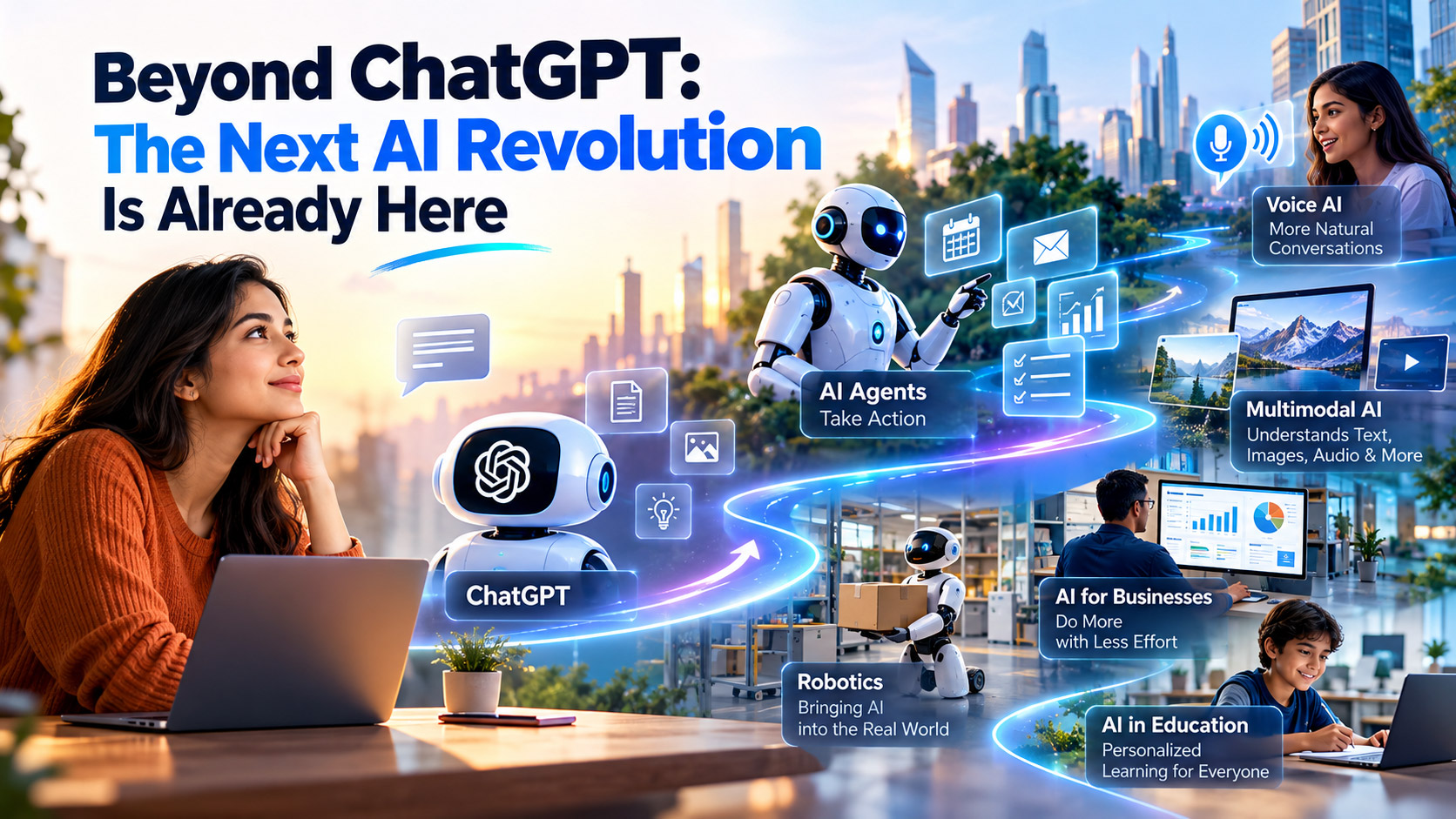
What If ChatGPT Is Only the Beginning?
Imagine waking up one morning and discovering that your AI assistant has already checked your emails, prepared your daily schedule, compared prices for something you want to buy, created a presentation, analyzed your business numbers, and even reminded you about an important meeting.
You did not ask it to do each task separately. It simply understood what you needed and took care of the work. Sounds like science fiction?
For the past few years, we have watched artificial intelligence grow rapidly. ChatGPT introduced millions of people to a new way of using technology. Instead of searching for information using keywords, people started talking to computers in normal language.
However, something much bigger is now happening.
The next AI revolution will not simply be about asking AI questions. It will be about giving AI the ability to understand goals, make decisions, use tools, and complete tasks.
And surprisingly, that future has already started.
ChatGPT Changed the Way We Use Computers
Do you remember how we used computers before AI assistants became popular?
We opened an application, searched through menus, typed commands, clicked buttons, and followed several steps to complete a task. ChatGPT changed that experience.
Instead of learning how software works, you could simply tell the AI what you wanted.
For example, you could say, “Write an email to my customer explaining the delay.”
The AI could understand the request and create the email within seconds. That simple experience changed people’s expectations.
People started asking an important question: If AI can understand what I say, why should I continue doing every small computer task myself?
That question leads us to the next stage of artificial intelligence.
AI Is Moving From Answers to Actions
Until recently, most people thought of AI as a tool that provides answers.
You ask something, AI responds.
You ask another question, AI responds again.
But what happens when AI can actually perform the task instead of simply explaining it?
That creates a completely different experience.
Imagine telling your AI assistant, “Find three suitable hotels in Chennai for my business trip next week, compare their prices, and prepare the best option for me.”
A traditional chatbot might give you a list. A more advanced AI system could search websites, compare information, organize the results, and prepare a recommendation.
That difference may look small. In reality, it represents a major shift.
AI is slowly moving from being a conversation partner to becoming a digital worker.
Have You Heard of AI Agents?
Here is where things become really interesting. Have you heard the term AI Agent?
An AI agent does more than answer questions. It can understand a goal and take multiple steps to achieve that goal. Think about hiring a personal assistant.
You do not tell your assistant every single click they need to make. You simply explain the objective.
For example, you might say, “Prepare a report about our website visitors this month.”A human assistant might collect the information, organize it, create charts, write observations, and prepare the report. AI agents aim to perform similar multi-step work digitally.
They can potentially interact with different software, websites, files, databases, and other tools. That means AI could become much more useful in everyday work.
What Makes AI Agents Different?
The biggest difference comes down to one word: action.
A chatbot mainly responds. An AI agent can plan. A chatbot can explain how to create an invoice. An AI agent could potentially create the invoice using the appropriate software. A chatbot can tell you how to analyze your sales data.
An AI agent could analyze the data, identify important changes, create a report, and prepare a summary. Of course, the exact capabilities depend on the tools and permissions available to the AI. Still, the direction is clear. AI increasingly wants to move from “Here is your answer” to “I have completed the task.”
AI Could Become Your Digital Team Member
Now imagine what this means for small businesses. A business owner may not have enough money to hire separate people for every task. Marketing requires one type of work. Customer support requires another. Data analysis requires another.
Content creation requires another. Website management requires another. AI could eventually help one person handle many of these responsibilities.
For example, an AI assistant could help prepare social media content in the morning, analyze website traffic in the afternoon, summarize customer feedback later, and prepare a business report at the end of the day.
It does not necessarily mean AI will replace every employee. Instead, AI could become a powerful teammate that helps people accomplish more with less effort.
What About AI That Can See and Hear?
Another major change involves how AI understands the world. Early AI systems mainly worked with text. Then AI became much better at understanding images. Now multimodal AI can work with combinations of text, images, audio, and other types of information.
Think about showing an AI a photograph of a broken machine. Instead of describing the problem in words, you could simply show the image and ask, “What could be wrong here?”
The AI could examine the image and explain possible causes. Similarly, voice-based AI can make conversations feel more natural. You can speak instead of typing. You can ask follow-up questions. You can interrupt.
You can continue the conversation naturally. This makes AI feel less like software and more like an assistant.
AI Is Entering the Real World
But there is another fascinating development. AI does not have to remain inside a computer. Robotics could bring AI into the physical world. Imagine a robot that can understand spoken instructions, recognize objects, learn from its environment, and perform physical tasks.
You could say, “Please move these boxes to the storage room.” Instead of following a fixed program, a smarter robot could understand the instruction and figure out how to accomplish it. We are still far from having human-like robots everywhere.
However, progress in robotics, computer vision, sensors, and AI models continues to push this field forward. The combination of AI and robotics could eventually become one of the biggest technology shifts of the coming decades.
What Happens When AI Can Use Every App?
Now let us imagine something even more powerful. What if your AI could work across all the applications you use?
Think about your daily digital life. You might use email for communication. A calendar for appointments.
A spreadsheet for finances. A messaging application for customers. A payment platform for transactions. A cloud drive for documents. A website platform for your business. Today, you normally move between these applications yourself.
Tomorrow, an AI assistant could potentially connect these activities. You could say, “Prepare everything I need for tomorrow’s client meeting.”
The AI could potentially find the previous emails, review the relevant documents, check the calendar, summarize the project, and prepare meeting notes. Suddenly, the computer becomes less like a collection of applications and more like one intelligent workspace.
Will AI Replace Jobs?
This is probably the question most people are thinking about. Will AI replace humans?
The honest answer is complicated. Some repetitive tasks will almost certainly become automated. Data entry provides a simple example.
If software can read information, understand it, and enter it automatically, humans may not need to perform the same repetitive work. However, jobs usually contain many different responsibilities.
Creativity, leadership, communication, judgment, empathy, negotiation, and decision-making still matter. Therefore, the bigger change may not be AI replacing humans.
It may be people who use AI becoming more productive than people who do not.
That distinction matters.
A designer using AI may produce work faster.
A developer using AI may explore solutions more quickly.
A business owner using AI may analyze information without hiring a large team.
A student using AI responsibly may understand difficult subjects more easily.
The advantage could come from collaboration rather than replacement.
The Rise of Personal AI
Another exciting possibility involves personal AI assistants.
Imagine an AI that understands your preferences, routines, projects, and working style.
Instead of starting every conversation from zero, your assistant could understand the context of your work.
For example, it could know that you prefer simple explanations.
It could understand the type of reports you normally create.
It could remember how you organize certain projects.
It could help you plan your day based on your priorities.
In other words, AI could become increasingly personalized.
However, this also creates an important concern.
How much personal information should we allow AI to access?
That question will become increasingly important as AI becomes more capable.
Privacy Will Become More Important Than Ever
More powerful AI needs more information to provide personalized assistance.
That information might include documents, emails, calendars, business data, conversations, or other personal information.
This creates a difficult balance.
People want convenience.
At the same time, they want privacy.
Companies will need to build stronger security systems as AI becomes deeply connected to everyday activities.
Users also need to understand what information they share with AI systems.
Convenience should never make us careless with sensitive information.
The future of AI will therefore involve two parallel goals: greater intelligence and stronger trust.
AI Could Change Education Completely
Think about a student struggling with a difficult subject.
In the past, the student might search Google, watch videos, read books, or wait for a teacher to explain the concept.
Now imagine having an AI tutor available at any time.
The student could say, “Explain this like I am ten years old.”
If that explanation does not work, the student could ask for another example.
Then the student could request a simple story.
Finally, the AI could create practice questions.
This creates a more personalized learning experience.
However, students must use AI as a learning partner rather than a shortcut.
There is a huge difference between asking AI to explain an answer and asking AI to complete your entire assignment.
AI Could Transform Small Businesses
Small businesses may experience one of the biggest benefits from the next AI revolution.
Why?
Because AI can potentially reduce the time required for many everyday tasks.
A small company could use AI to prepare marketing ideas, analyze customer feedback, draft proposals, organize information, create reports, and assist with customer communication.
That could allow small teams to compete with much larger organizations.
Imagine a company with five employees operating with the productivity of a much larger team because each employee has an AI assistant.
That possibility could completely change the competitive landscape.
The New Skill: Knowing What to Ask AI
There is another interesting change happening.
People once needed to learn how to operate software.
Now they increasingly need to learn how to communicate with AI.
You may hear the term prompt engineering.
The basic idea sounds complicated, but the concept is simple.
You need to explain your goal clearly.
Instead of saying, “Write something about marketing,” you could say, “Write a simple 500-word article about digital marketing for small businesses, using practical examples.”
The clearer your instructions, the more useful the result can become.
However, as AI systems become better at understanding natural language, people may not need complicated prompts forever.
The future could involve simply explaining what you want, just as you explain a task to another person.
AI Will Not Always Get Everything Right
Here is something we should never forget.
AI can make mistakes.
Sometimes it may confidently provide information that sounds correct but contains errors.
That means human judgment still matters.
You should verify important financial, legal, medical, business, and technical information before acting on it.
AI can help you think faster.
It should not replace your responsibility to think carefully.
This point becomes even more important as AI starts taking actions instead of simply providing answers.
The more power we give AI, the more carefully we need to control and review its actions.
So, What Comes After ChatGPT?
The next AI revolution probably will not arrive as one single product.
Instead, it will develop through many technologies working together.
AI agents will handle tasks.
Voice AI will make conversations natural.
Multimodal AI will understand different types of information.
Robotics will bring intelligence into the physical world.
AI-powered software will automate everyday work.
Personal AI assistants will understand individual needs.
Together, these technologies could create something much bigger than today’s chatbot experience.
ChatGPT may eventually look like the beginning of the AI journey rather than its destination.
The Real AI Revolution Has Already Started
We often imagine revolutions as dramatic moments.
A new device launches.
A company announces a breakthrough.
Everyone suddenly changes the way they work.
The AI revolution may look very different.
It may happen quietly.
One person starts using AI to write reports.
Another uses it to analyze data.
A student uses it as a tutor.
A developer uses it to build software.
A business owner uses it to automate repetitive tasks.
A company connects AI to its internal systems.
Slowly, these small changes become a massive transformation.
That transformation has already begun.
The Question We Should Really Ask
The most interesting question is no longer, “Will AI become powerful?”
AI is already becoming powerful.
The better question is:
“What will we do with that power?”
Will we use AI only to create funny images and write quick messages?
Or will we use it to solve difficult problems, build better businesses, improve education, save time, and create things we could never create alone?
The answer will depend on us.
The next AI revolution may not be about machines becoming more human.
It may be about humans becoming capable of doing things that once seemed impossible.
And perhaps, years from now, we will look back at ChatGPT and realize something surprising:
It was not the AI revolution. It was the moment many of us first realized that the revolution had begun.
So, what do you think?
If AI agents could handle five hours of your daily work tomorrow, which five hours would you give them? And more importantly, what would you do with the time you get back?
Maybe that is a question worth sharing with a friend, colleague, or business owner who still thinks AI is “just another chatbot.”
Frequently Asked Questions
1. What comes after ChatGPT?
The next stage of AI focuses on AI agents, multimodal systems, personalized assistants, robotics, and AI-powered automation. These systems aim to perform tasks instead of simply answering questions.
2. What is an AI agent?
An AI agent is an AI system that can understand a goal, plan multiple steps, use available tools, and work toward completing the task. It can potentially perform more complex jobs than a traditional chatbot.
3. Will AI replace humans?
AI will automate many repetitive tasks, but it will not necessarily replace humans entirely. People who learn to work effectively with AI may gain a significant advantage in many industries.
4. How will AI change small businesses?
AI can help small businesses with content creation, customer support, data analysis, marketing, research, reporting, and repetitive administrative work. This could help small teams accomplish more with fewer resources.
5. Is ChatGPT the future of AI?
ChatGPT represents an important stage in the development of generative AI, but AI continues to evolve. AI agents, robotics, multimodal systems, and personalized AI could become equally important parts of the next generation.