

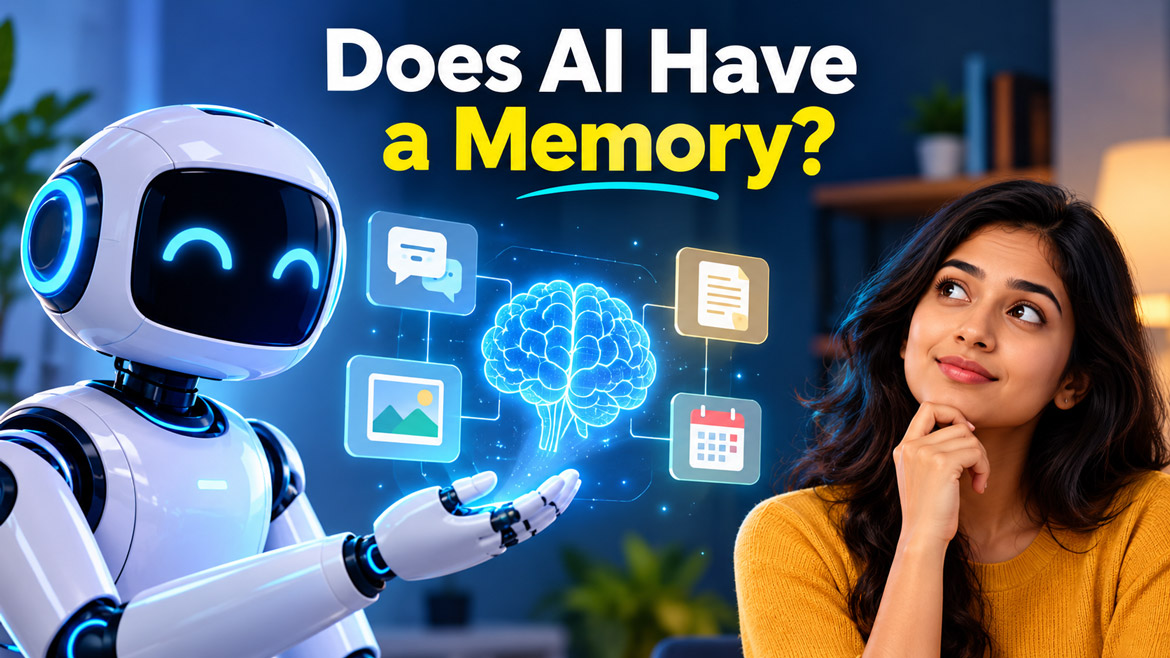
Imagine talking to an AI assistant today about your business, your interests, and your future plans. Tomorrow, you open the same assistant and ask a simple question. Suddenly, it remembers your preferences and continues the conversation as if you never left. Sounds amazing, right?
But here is a question that might surprise you: Does AI really remember you, or does it simply act as if it remembers?
The answer is more interesting than you might think. Artificial intelligence can remember certain details, learn from information, and use previous conversations in some situations. However, its memory works very differently from the human brain.
Understanding this difference helps us discover what AI can do, what it cannot do, and how it might change our lives in the future.
What Does Memory Mean in Artificial Intelligence?
When we hear the word memory, we usually think about our own experiences. We remember our childhood, our first school, our friends, and the important moments in our lives. These memories help us understand the world and make better decisions.
But does AI remember things in the same way? Not exactly. AI uses different methods to store information, process past interactions, and retrieve useful details when needed. Some AI systems can remember information from previous conversations, while others only work with the information available in the current session.
For example, imagine telling an AI assistant that you prefer simple English when reading technical articles. If the assistant remembers this preference, it might write future articles in simple English without asking you again. This ability makes AI more useful and convenient. Nevertheless, it does not mean the AI remembers your conversation like a human friend.
How Does AI Remember Information?
Have you ever wondered how an AI assistant can remember a detail from an earlier conversation? The answer depends on the type of memory the system uses. Different AI systems handle information in different ways, but we can understand the main methods through three simple categories.
1. Short-Term Memory: Remembering the Current Conversation
Short-term memory helps an AI system work with information from the conversation it currently handles. Think of it as a temporary notebook that contains the details needed to answer your questions.
Suppose you ask an AI assistant to plan a family holiday. You explain your budget, preferred destination, travel dates, and interests. The assistant can use these details to suggest suitable hotels, attractions, and travel plans during that conversation.
However, if you start a completely new conversation, the assistant might not have access to those details. Its ability to continue the discussion depends on whether the system preserves the earlier conversation or provides another way to retrieve it.
This type of memory helps AI follow a discussion without asking you to repeat every detail. Still, short-term conversational memory has limits. Long conversations may exceed the amount of information the system can handle at once, and some earlier details may become unavailable or less influential.
2. Long-Term Memory: Remembering Useful Details Over Time
Now imagine an assistant that remembers your writing preferences even after several days. You no longer need to explain your preferred style every time you request an article.
Some AI services offer long-term memory features that save selected information across conversations. Depending on the service and its settings, this information might include your interests, work preferences, recurring projects, or preferred response style.
For example, a business owner might regularly ask an AI assistant to write marketing content. If the assistant remembers the business’s services and target audience, it can create more relevant content in future conversations.
This approach saves time and makes the experience feel more personal. However, long-term memory does not necessarily preserve every conversation. The system may store only selected details, summarize important information, or retrieve relevant information from an approved source.
In other words, AI memory often works more like a collection of useful notes than a complete recording of your life.
3. External Memory: Looking Up Information When Needed
Can AI remember thousands of pages of information without storing every detail inside its own model? Yes, some systems can use external information sources to find relevant details when answering questions.
These sources might include documents, databases, previous conversations, company records, or approved knowledge bases. The AI retrieves relevant information and uses it to prepare an answer.
Imagine a company that uses an AI assistant to answer questions about its products. Instead of relying only on its general training, the assistant can search the company’s product catalogue and support documents.
When a customer asks about a product’s warranty, the assistant can retrieve the relevant policy and explain it in simple language.
This method resembles a person looking up information in a filing cabinet or digital library. The information does not need to exist entirely inside the AI model itself.
However, the system needs appropriate access to the information source. If the document is missing, outdated, or inaccessible, the answer may be incomplete or incorrect.
Does ChatGPT Remember Your Previous Conversations?
ChatGPT is a familiar example of an AI assistant, so let’s use it to understand how AI memory works in everyday life.
Depending on your settings and the features available to your account, ChatGPT can use information from the current conversation, saved memories, and previous chat history. These capabilities are different, and they do not necessarily work in the same way for every user.
For instance, you might tell ChatGPT that you run a web development business and prefer articles written in simple English. If the relevant memory features are available and enabled, ChatGPT may use those details to personalize future responses.
However, you should not assume that ChatGPT remembers every word from every conversation. Some details may never become saved memories, and access to previous chat information can depend on your settings and the features you use.
It is also important to understand that remembering information during a conversation is not the same as permanently storing it for future use.
If you want to understand your own experience, check the memory and personalization settings available in your ChatGPT account. These settings help you understand how the service uses remembered information and what controls you have.
Does AI Learn Something New Every Time You Talk to It?
Here is another interesting question: If you correct an AI assistant today, will it automatically become smarter for everyone tomorrow?
The answer is generally no. AI can use your correction within the current conversation, but that does not necessarily change the underlying model.
Imagine asking an AI to calculate a percentage. It gives an incorrect answer, and you explain the mistake. The assistant can use your correction to reconsider the calculation and provide a better answer during the discussion.
However, this does not automatically mean that the AI has permanently learned the correct method. Its underlying model parameters may remain unchanged.
Developers can improve AI models through processes such as training, fine-tuning, evaluation, and updates. Depending on the service’s policies, developers may also use certain interactions to improve future systems.
Nevertheless, a single conversation does not automatically update every AI model or teach the same lesson to every user.
This distinction matters because AI can appear to learn from you without permanently changing how the entire system works.
How Is AI Memory Different From Human Memory?
At first glance, AI memory and human memory might seem similar. Both can help us use earlier information to answer new questions. However, their underlying processes differ significantly.
Human memory develops through experiences, emotions, senses, relationships, and biological processes. A meaningful conversation with a friend might stay in your memory for decades because it connects with your personal experiences.
AI systems handle information through computational processes. They can store selected facts, retrieve documents, process conversation history, and use patterns learned during training. These capabilities do not establish that an AI experiences memories or emotions like a person.
Consider a simple example. You tell an AI assistant about your first day at school. It might later repeat the details if the conversation remains available or the system stores that information.
A human friend, however, might remember your story alongside the emotions, reactions, and shared experiences connected to it.
AI can generate language that sounds caring and personal. Yet, that ability alone does not prove that it experiences nostalgia, happiness, sadness, or affection.
AI can use information about your past without experiencing that past as a human does.
Can AI Forget What You Tell It?
Yes, an AI system can lose access to information, stop retrieving it, or remove stored details when its memory features allow that action.
But what does forgetting actually mean for AI? It depends on where the information exists.
If a detail appears only in the current conversation, the assistant may no longer have access to it in a separate session. If a service stores selected memories, its memory controls may allow you to update or remove them.
External sources create another consideration. If information also exists in a document, connected application, or saved conversation, removing one memory may not remove every copy.
For example, suppose an assistant remembers your preferred writing style. You later change that preference. Updating the stored memory, where supported, can help future responses follow your new preference.
However, removing a saved memory does not necessarily delete the original conversation or every other source containing the same information.
Therefore, you should understand the service’s privacy controls before sharing sensitive information. Check its options for memory, chat history, data management, and connected sources.
Is AI Memory Safe? What About Your Privacy?
AI memory can make digital assistants more helpful, but it also raises an important question: How much personal information should an AI system remember?
Imagine an assistant that remembers your favourite writing style, business goals, and frequently used project details. These memories can save time and improve the relevance of its responses.
Now imagine storing passwords, bank account details, private medical information, or confidential business records in the same system. Such information requires much greater care.
The safest approach is to share only what the task requires. Avoid entering passwords, authentication codes, or other highly sensitive information into ordinary conversations.
You should also review the service’s privacy policies and available data controls. Depending on the product, you may have options to manage saved memories, control chat history, or limit how your interactions contribute to model improvement.
For businesses, administrators should consider access permissions, data retention, employee policies, and the security of connected applications.
Remember that AI memory and AI privacy are related, but they are not the same thing. A system might store useful preferences while protecting them with suitable controls, or it might create risks if it handles information carelessly.
Ultimately, convenience should never come at the cost of careless data sharing.
Why Does AI Sometimes Remember Things Incorrectly?
Have you ever received an answer from an AI assistant that sounded confident but contained a mistake? Similar problems can occur when AI works with remembered information.
An AI system may retrieve an outdated detail, misunderstand an earlier statement, or connect two unrelated pieces of information. It might also generate an incorrect answer when the relevant information is missing.
For example, imagine telling an assistant that your meeting takes place on Monday. Later, you change the meeting to Tuesday. If the assistant uses an old note, it might still refer to Monday.
This problem becomes more important when an AI assistant helps with business operations, customer support, scheduling, or research.
To reduce these errors, users should correct outdated information, review important details, and verify critical answers against reliable sources.
Developers can also improve retrieval methods, introduce validation checks, and design systems that distinguish confirmed facts from uncertain information.
Even so, no memory system guarantees perfect recall. AI users should treat remembered information as useful assistance rather than unquestionable truth.
How AI Memory Could Change Our Future
AI memory could transform the way we interact with computers over the coming years. Instead of explaining our preferences repeatedly, we may work with assistants that understand our ongoing projects and retrieve relevant information when needed.
Imagine a personal learning assistant that remembers which subjects you have studied and identifies areas that need more practice. It could suggest suitable lessons based on your progress.
A business assistant might remember project requirements, summarize earlier discussions, and help team members find decisions from previous meetings. A writing assistant could maintain your preferred tone and formatting across multiple articles.
Healthcare systems could also use carefully controlled patient information to help professionals review relevant records. However, medical decisions would still require appropriate clinical judgment, safeguards, and human oversight.
These possibilities offer exciting benefits, but they also demand responsible design. Developers must consider privacy, security, accuracy, user consent, and the ability to correct outdated information.
The future of AI memory will depend not only on how much information systems can retain, but also on how responsibly they use it.
Could AI One Day Remember Everything?
Imagine an AI assistant that remembers every conversation, every document you share, and every project you have worked on. Would that make it the perfect personal assistant?
Not necessarily. Remembering more information does not always produce better decisions.
A useful assistant must identify which details matter, recognize outdated information, respect privacy, and retrieve the right facts at the right time.
Think about your own life. You probably remember important birthdays and meaningful experiences, but you do not need to recall every sentence from every conversation. Human memory also selects, reorganizes, and sometimes loses information.
AI systems face a different challenge, but the principle remains useful: relevant information often matters more than unlimited storage.
Future systems may combine larger context windows, improved memory features, searchable personal knowledge bases, and better reasoning methods. These advances could help AI maintain more useful context across complicated tasks.
However, no one can guarantee that AI will remember everything accurately or behave exactly like a human being. More memory also creates new questions about ownership, consent, and the right to remove personal information.
The real goal should not be to create an AI that remembers everything. It should be to create an AI that remembers the right information, uses it responsibly, and helps people make better decisions.
Frequently Asked Questions About AI Memory
1. Does AI have a memory like humans?
No. AI can store, retrieve, and use information, but it does not remember experiences in the same way humans do. Human memory involves biological processes, emotions, and personal experiences, while AI relies on computational systems.
2. Does ChatGPT remember everything I tell it?
No. ChatGPT does not necessarily retain every detail from every conversation. Its ability to use previous information depends on the available memory features, your settings, and the context provided to it.
3. Can AI remember me after I close the application?
Some AI services can remember selected information across sessions when their memory features support it. Other systems may only use information available during the current session. The exact behaviour depends on the product and its settings.
4. Can I delete something AI remembers about me?
Many AI services provide controls for managing saved memories. However, deleting a memory may not automatically delete the original conversation or copies stored in other sources. Check the service’s memory and data management settings for the available options.
5. Will AI become smarter because it remembers our conversations?
Not automatically. AI can use conversation details to respond more appropriately, but this does not necessarily change the underlying model. Developers typically use separate training, evaluation, or update processes to improve model capabilities.
Final Thoughts: AI May Remember Your Words, But What Matters Is How It Uses Them
AI memory is more than a technical feature. It represents an important step towards digital assistants that can understand our ongoing work, remember useful preferences, and help us complete tasks with less effort. At the same time, we must understand its limitations and protect the information we share.
AI does not need to remember everything to become useful; it needs to remember relevant information accurately, respect our privacy, and help us make informed decisions. As AI continues to evolve, one question becomes increasingly important:
If an AI assistant could remember your preferences, ideas, and experiences for years, what would you want it to remember about you, and what would you never want it to forget? Share this article with your friends and colleagues, and ask them the same question. Their answers might reveal something fascinating about how we want to live and work alongside artificial intelligence