

Imagine showing an AI assistant a photograph, asking a question about it, and then requesting a video that explains what you see. The assistant could connect the image with your words and help turn your idea into something completely new. What once sounded like science fiction is now becoming part of everyday technology.
But how can a computer understand written words, recognize objects in photographs, interpret human speech, and make sense of moving images?
The answer lies in a fascinating technology called Multimodal AI. It is changing how we communicate with computers, create content, learn new skills, and solve everyday problems. Let’s explore how it works, why it matters, and what it could mean for our future.
What Is Multimodal AI?
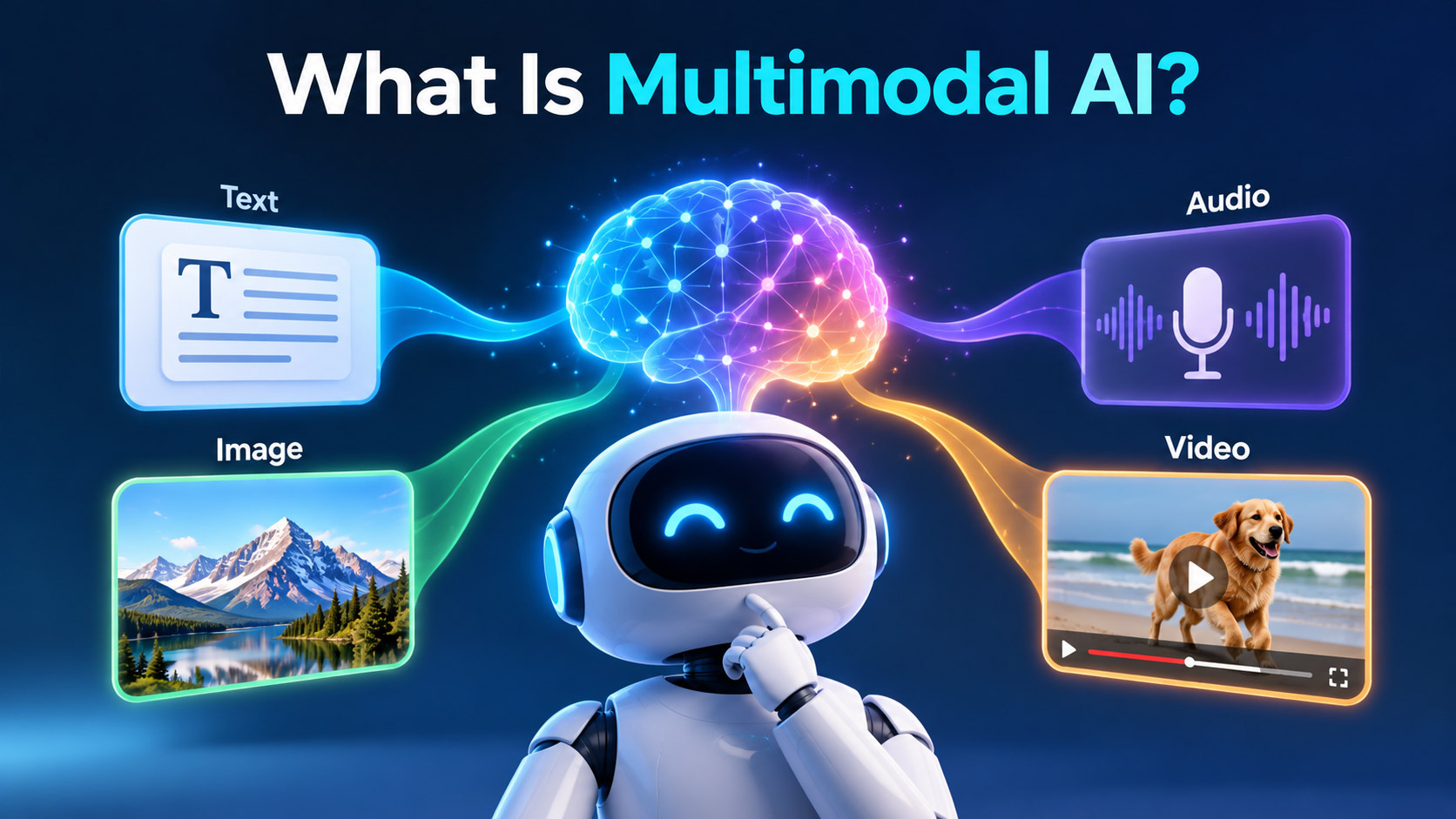
Multimodal AI is a type of artificial intelligence that can process and connect different types of information, such as text, images, audio, and video. The word “multimodal” combines two ideas: “multi” means many, while “modal” refers to a mode or type of information.
Think about how you understand a conversation with a friend. You listen to their words, notice their facial expressions, observe their gestures, and pay attention to the situation around you. Together, these clues help you understand what your friend means. Multimodal AI follows a similar broad approach by connecting information from different sources.
For example, imagine uploading a photograph of a damaged mobile phone and asking, “What is wrong with this phone?” An AI assistant with image-understanding capabilities might identify a cracked screen and explain possible repair options. If you also describe what happened, the system can use your explanation alongside the photograph to provide a more relevant response.
Why Does Multimodal AI Matter?
Have you ever wished you could simply show a computer something instead of describing it in a long message? Multimodal AI makes this kind of interaction possible. It allows people to communicate with technology using the forms of information that suit them best.
A text-only AI assistant can explain a concept, answer a question, or summarize a document. However, words alone may not provide enough information to understand a complicated scene, recognize a sound, or explain an action in a video.
Multimodal AI expands these possibilities. A student can upload a photograph of a mathematics problem and request a step-by-step explanation. A traveller can show a picture of a sign in another language and ask for a translation. Similarly, an online business owner can provide product photographs and request descriptions for an e-commerce website.
As a result, AI becomes more flexible and accessible. People can interact with technology using words, pictures, and speech rather than relying entirely on typed instructions.
The Four Main Types of Information Multimodal AI Can Understand
Multimodal AI can work with several forms of information. Four important examples are text, images, audio, and video. Each form offers different clues, and combining them can help an AI system understand a task more effectively.
1. Text: Understanding Human Language
Text includes messages, emails, articles, questions, reports, and documents. AI language models learn patterns in language that help them interpret questions and generate meaningful responses.
For example, you might ask an AI assistant, “Explain cloud computing to a beginner.” The system can interpret your request and create an explanation using simple words. You could then ask it to shorten the answer, provide examples, or translate it into another language.
However, words sometimes have different meanings depending on the context. Consider the sentence, “The bank is crowded today.” The word “bank” could refer to a financial institution or the side of a river. The surrounding information helps clarify the intended meaning.
Multimodal AI can use additional information to resolve some of these ambiguities. If you provide a photograph of a riverbank alongside your question, the image may help the system understand which meaning you intend.
2. Images: Understanding What a Picture Shows
A picture can communicate information that would take hundreds of words to describe. It can show objects, colours, shapes, people, written signs, and relationships between different things.
But how does AI process an image? A computer receives digital image data containing patterns of colour, brightness, and shape. AI models learn to connect these patterns with concepts such as a dog, a tree, a car, or a traffic signal.
Imagine showing an AI system a photograph of a crowded railway station. Depending on its capabilities, the system might identify trains, platforms, passengers, and signboards. You could then ask it to describe the scene or read visible text.
Image understanding supports many practical applications. Online sellers can generate product descriptions from photographs, designers can request feedback on website layouts, and specialized medical systems can help professionals analyse medical images.
The ability to connect visual information with language makes these applications especially useful. Instead of describing every detail in a picture, you can ask a direct question about what you see.
3. Audio: Understanding Speech and Sounds
Audio carries much more than spoken words. A recording can contain conversations, music, traffic, birds singing, machine noises, or the sound of rain. AI systems with audio capabilities can process different aspects of these sounds.
Consider a simple example. You record a voice message and ask an AI assistant to summarize it. The system may recognize the spoken words, identify the main points, and prepare a concise summary. Some systems can also respond through speech, making the interaction feel more like a conversation.
Audio AI involves several related tasks. Speech recognition converts spoken language into text. Audio classification identifies sound categories. Speaker-related processing can help distinguish voices, while speech generation creates spoken output from text.
Imagine a technician recording an unusual sound from a machine. An AI tool might help describe the sound and identify patterns that deserve further investigation. Similarly, audio tools can help people convert meetings into written notes or generate captions for spoken content.
These capabilities also support accessibility. Speech-to-text tools can assist people who have difficulty hearing, while spoken AI responses can help people who prefer listening to reading.
4. Video: Understanding Moving Images
Video introduces another dimension because it combines visual information across time. A single video may contain thousands of frames, along with speech, background sounds, and changes in movement.
A photograph shows one moment, while a video reveals how a scene changes. This makes video understanding useful for tasks involving actions, events, and sequences.
Imagine uploading a video of someone assembling a chair. An AI system with video-understanding capabilities might identify the assembly steps, explain the tools involved, and summarize the process. A teacher could use a recorded classroom demonstration to prepare notes for students.
Video AI can also help summarize meetings, analyse sports footage, inspect industrial processes, and search large collections of recorded content. Some AI tools can even generate new videos from text descriptions or reference images.
The ability to connect events across time makes video one of the most interesting areas of multimodal AI. It allows users to ask questions about what happened, how an action unfolded, or what a particular scene contains.
How Does Multimodal AI Combine Text, Images, Audio and Video?
Now comes the most interesting question: how can an AI system connect a written question with a photograph, a voice recording, or a video?
Although the exact process varies between systems, we can understand the basic idea through four simple steps.
Step 1: The AI Receives Different Inputs
First, the system receives the information you provide. You might type a question, upload an image, record your voice, or share a video. Some AI systems accept several of these inputs within the same interaction.
Imagine asking, “Why is this plant turning yellow?” while uploading a photograph and explaining how often you water it. The system now has a written question, visual information, and additional context from your explanation.
Each input contributes a different clue. The photograph shows the plant’s visible condition, while your explanation provides information about its care.
Step 2: The AI Converts Inputs Into Useful Representations
Computers process information through mathematical operations. AI models therefore need ways to represent words, images, and sounds in forms they can process.
For text, a model commonly divides language into smaller units called tokens. For images, a vision model may analyse patches or other visual features. For audio, a model may process sound signals or learned representations. Video systems may analyse individual frames and information about changes over time.
Think of this stage as translating different forms of information into formats the computer can work with. Although the technical methods differ, they help the system identify useful patterns in the information it receives.
Step 3: The AI Connects Related Information
Next, the model uses patterns learned during training to connect relevant clues. Some systems process different types of information through separate components before combining their representations. Others use architectures designed to process multiple modalities more directly.
For example, a model might connect the word “cat” with the visual features of a cat in a photograph. It might also associate a meowing sound with the same concept.
These connections help the AI respond when a user combines language, images, and audio. Instead of treating every input as a separate task, the system can use information from several sources to produce a more relevant answer.
Step 4: The AI Generates a Response
Finally, the system produces an answer based on the information it receives and the patterns it learned during training. Depending on its capabilities, the response might contain text, spoken words, a generated image, or a video.
Suppose you upload a photograph of a bicycle and ask, “How can I repair this loose part?” The system may identify the visible component and explain possible repair steps. If you request spoken instructions, a capable system may provide an audio response.
This process creates a more natural way to interact with technology. You can ask questions, provide context, and request different types of output within the same workflow.
What Is the Technology Behind Multimodal AI?
You do not need to understand complicated mathematics to grasp the main technologies behind multimodal AI. Three important ideas explain how these systems learn and connect information.
Neural Networks: Learning Patterns From Examples
A neural network is a computer system inspired loosely by how biological brains process information. It contains connected mathematical units that learn patterns from training examples.
During training, the system adjusts its internal parameters to improve its performance. For example, an image model can learn visual patterns associated with cats by processing many training examples. A language model learns patterns in text that help it predict and generate words.
Neural networks provide a powerful way to recognize patterns across large amounts of data. Different networks can specialize in language, vision, audio, or combinations of these areas.
Transformers: Connecting Important Information
Transformers are a type of neural network architecture that plays a major role in modern AI. One important feature is attention, a mechanism that helps a model weigh relationships between different parts of its input.
Consider the sentence, “The boy dropped the glass because it was slippery.” To interpret the sentence, a language model needs to consider how different words relate to one another.
Related techniques can help multimodal models connect words with image regions or other pieces of information. For example, a model can use a question’s wording to focus on relevant details within an uploaded photograph.
Not every multimodal AI system uses an identical architecture. Some combine several specialized models, while others use designs that process different types of information more directly.
Training Data: Learning Connections Across Modalities
AI models need suitable training data to learn relationships between different forms of information. Depending on the system, training may involve text, images, audio recordings, video, and examples that connect these sources.
For example, image-text pairs can help a model learn how written descriptions relate to visual content. Audio recordings paired with transcripts can help a system connect spoken language with text.
The quality and diversity of training data influence what a model learns. Developers therefore need suitable examples to help models handle different environments, languages, subjects, and situations.
Real-World Applications of Multimodal AI
Multimodal AI is not simply a research concept. It can support practical work across many industries, from healthcare and education to business and entertainment.
Healthcare: Helping Professionals Analyse Information
Healthcare professionals work with medical images, written reports, patient conversations, and monitoring data. Specialized AI systems can help organize or analyse selected types of information.
For example, an AI tool may help a clinician review a medical image alongside relevant clinical notes. Other applications can assist with medical documentation or organize information from patient interactions.
These tools can support healthcare professionals, but qualified clinicians must retain responsibility for medical decisions.
Education: Making Learning More Interactive
Imagine a student struggling to understand a science experiment. Instead of reading a textbook alone, the student could share a photograph and ask the AI to explain each step in simple English.
A capable system might also interpret a spoken question, summarize a lesson video, or create practice questions from a diagram. Teachers can use similar tools to prepare educational materials and make lessons more engaging.
This approach gives students additional ways to explore difficult topics. They can learn through written explanations, visual examples, and spoken instructions according to their needs.
Business: Saving Time and Improving Productivity
Businesses manage emails, documents, product photographs, customer calls, and training videos every day. Multimodal AI can help connect these different sources of information.
For example, an online retailer could use product photographs and written specifications to prepare product descriptions. A sales team might summarize a meeting recording and connect the discussion with an existing document.
Customer support teams could also use photographs submitted by customers to understand product issues. These applications can reduce repetitive work and help employees find relevant information more quickly.
Manufacturing: Supporting Quality Checks
Factories often need to identify scratches, damaged components, unusual machine sounds, or changes in operating conditions. Specialized AI systems can analyse images, video, and audio to help detect possible problems.
For instance, a visual inspection system may flag a product with a visible defect. Another system might analyse machine sounds for patterns associated with unusual operation.
By combining these sources, manufacturers can gather more information about a process. This can support quality control, equipment maintenance, and production monitoring.
Entertainment and Content Creation
Have you ever wanted to turn a simple idea into an engaging video without using complicated editing software? Multimodal AI is making parts of this process easier.
Depending on the tools available, creators can use text prompts to generate images, animate reference images, create narration, or produce video clips. They can also analyse existing footage and generate captions or summaries.
For example, a creator could start with a description of a magical golden sphere, generate a reference image, and use an image-to-video tool to animate it. Separate audio tools could then help create suitable sound effects.
These capabilities give creators new ways to experiment with visual storytelling, animation, and digital content production.
What Is the Difference Between Traditional AI and Multimodal AI?
The main difference lies in the types of information a system can process and how it connects them. Traditional AI can specialize in a single task, such as classifying images, recognizing speech, or processing text. Multimodal AI can combine several forms of information when its design supports those capabilities.
Consider a simple comparison. A speech recognition tool might convert your spoken question into written text. An image recognition tool might identify a bicycle in a photograph. A multimodal assistant could use the photograph and your spoken question together to explain a visible problem with the bicycle.
However, the distinction is not always absolute. Some traditional systems already process more than one type of input, and some multimodal models support only a limited combination of modalities.
Therefore, when evaluating an AI tool, look at the inputs it supports, how effectively it connects them, and whether its capabilities match your needs.
What Are the Limitations of Multimodal AI?
Although multimodal AI offers exciting possibilities, it still faces several challenges. Understanding them helps us use the technology more effectively.
Accuracy: An AI system can misidentify objects, misinterpret speech, or miss important moments in a video. Poor lighting, background noise, and unclear information can make these problems worse.
Incorrect answers: AI can sometimes produce convincing explanations that contain factual mistakes. Combining several inputs may improve context, but it does not guarantee a correct answer.
Privacy: Photographs and recordings may contain faces, addresses, confidential documents, or private conversations. Users should understand a service’s data-handling practices before sharing sensitive information.
Bias: Training data can contain social, cultural, or language biases. Developers need to test their systems across different situations and work to reduce unfair outcomes.
Computing costs: Processing high-resolution videos, long audio recordings, and multiple input types can require significant computing resources. These costs can affect speed, availability, and pricing.
For important decisions, people should verify AI-generated information and retain responsibility for their choices. In healthcare, finance, and safety-related work, professional oversight remains essential.
How Can You Start Using Multimodal AI?
You do not need to be a programmer or technology expert to explore multimodal AI. Many modern AI applications offer simple interfaces for asking questions, uploading images, or interacting through voice.
Start with an everyday task. Take a photograph of a plant and ask the AI to describe its visible features. Next, share a screenshot of a website and request suggestions for improving its layout.
If your chosen tool supports audio or video, ask it to summarize a short recording or explain a demonstration. You can also experiment with creating images from text descriptions and turning reference images into short video clips.
As you explore, provide clear instructions and useful context. Ask follow-up questions to refine the results, and check important factual claims against reliable sources. Remember that different AI applications support different features, so check their capabilities before choosing a tool.
What Does the Future Hold for Multimodal AI?
The future of multimodal AI could bring more natural ways to interact with computers. Instead of switching between separate applications for typing, listening, viewing, and creating, people may increasingly use systems that connect these activities within a single workflow.
Imagine an AI assistant helping you plan a journey. You could describe your preferences through speech, share a map, upload hotel details, and ask for a visual itinerary. A capable system could combine the available information to prepare a more useful response.
In education, students may interact with lessons through text, diagrams, speech, and demonstrations. In business, teams may search across documents, recordings, and visual reports. In creative work, people may move more easily from an idea to an image, a video, and a narrated presentation.
Progress will depend on improvements in accuracy, privacy, accessibility, and affordability. The goal is not simply to build AI that handles more information, but to create tools that genuinely help people solve problems.
Conclusion: AI Is Learning to Connect the Dots
Multimodal AI represents an important step towards technology that can work with the different ways humans communicate and share information. By combining text, images, audio, and video, these systems can tackle tasks that would be difficult for a text-only assistant.
Yet the real value of multimodal AI does not come from processing more types of data. It comes from using different clues to help people learn, create, communicate, and solve everyday problems. This technology is opening new possibilities for students, businesses, professionals, and content creators.
Think about how you use technology today.
What if you could explain an idea simply by speaking, showing a picture, or sharing a short video—and your AI assistant could connect all those clues to help bring that idea to life?
That possibility is what makes multimodal AI so exciting. If this article helped you understand the technology, share it with a friend, student, or colleague who wants to explore the future of AI. And here is one final question:
Which would change your daily life the most—a smarter AI that understands what you see, what you hear, or all these things together?
Frequently Asked Questions (FAQs)
1. What is multimodal AI in simple words?
Multimodal AI is artificial intelligence that can process and connect different types of information, such as text, images, audio, and video. It allows people to interact with AI in more natural and flexible ways.
2. How does multimodal AI understand images and text together?
The AI processes the text and image using suitable model components or learned representations. It then connects relevant patterns to interpret the question in relation to the image and generate a response.
3. What are some examples of multimodal AI?
Examples include AI assistants that answer questions about photographs, tools that summarize videos, systems that understand spoken questions, and applications that generate images or videos from text prompts. Exact capabilities vary between products.
4. What is the difference between generative AI and multimodal AI?
Generative AI creates new content, such as text, images, audio, or video. Multimodal AI processes multiple forms of information. These concepts overlap because a multimodal AI system can also generate content, but not every generative AI system supports multiple input types.
5. Will multimodal AI replace human intelligence?
Multimodal AI can automate selected tasks and assist with complex work, but it does not reproduce every aspect of human understanding and experience. It is best viewed as a tool that supports human abilities rather than a complete replacement for human intelligence.