

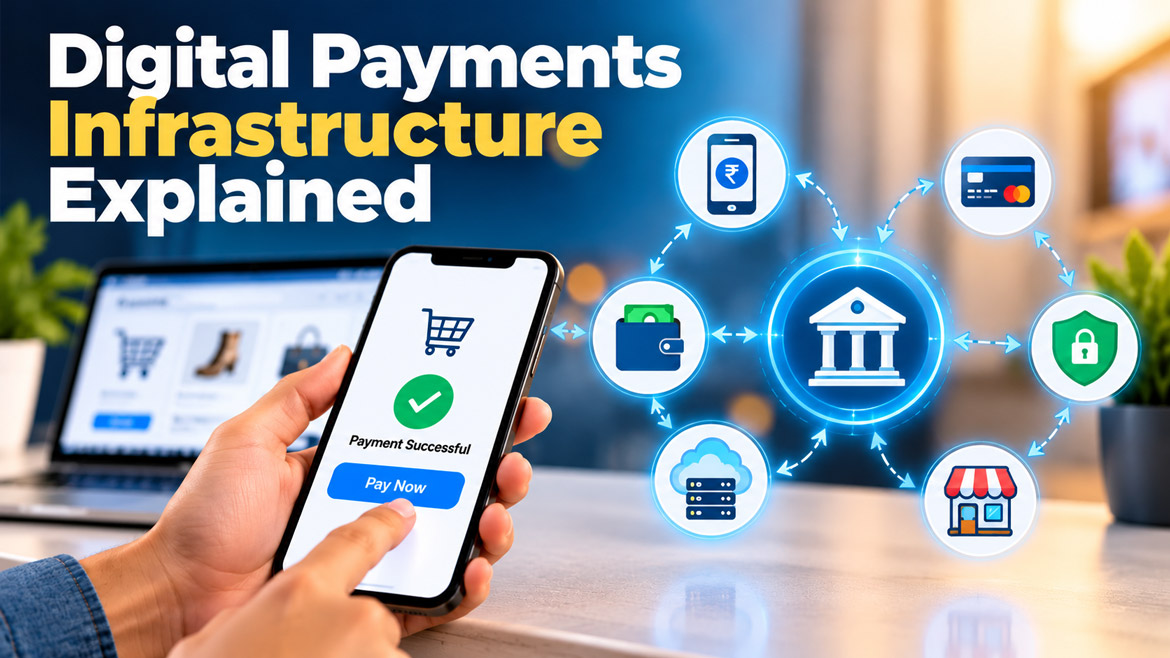
Have you ever wondered what happens when you scan a QR code, tap your phone, or click “Pay Now” while shopping online?
Within seconds, your money can move from your bank account to another person or business, often without you seeing a single rupee change hands. But behind that simple action lies a powerful network of banks, payment gateways, security systems, and financial technologies working together.
What makes this possible?
More importantly, how does this entire system know where your money should go, whether you have enough balance, and when to approve or reject a payment?
Welcome to the fascinating world of digital payments infrastructure, the invisible technology that keeps our digital economy moving.
What Is Digital Payments Infrastructure?
Digital payments infrastructure refers to the collection of technologies, financial institutions, networks, and security systems that make electronic money transfers possible. It allows people and businesses to send and receive money without exchanging physical cash.
Whether you pay a shopkeeper through UPI, purchase a product from an online store, or transfer money using mobile banking, digital payments infrastructure works behind the scenes.
Think of it as a digital highway for money. Just as roads connect cities and allow vehicles to reach their destinations, payment networks connect customers, merchants, banks, and financial institutions.
Each part performs a specific job, ensuring that money reaches the correct destination safely and efficiently.
Today, this infrastructure supports everything from small tea-shop payments to international business transactions. Consequently, it has become one of the most important foundations of modern commerce.
Why Do We Need Digital Payments Infrastructure?
Imagine a world where every online purchase requires you to visit a bank, withdraw cash, and deliver it personally to the seller. Shopping would become slow, businesses would struggle to serve customers, and international trade would face even greater challenges.
Digital payments solve these problems by allowing people to transfer money electronically. Customers can pay at any time, businesses can collect payments from different locations, and financial institutions can process transactions through connected systems.
Moreover, digital payments reduce the need to handle cash, simplify recordkeeping, and help businesses manage their finances. Small businesses can accept payments using QR codes instead of investing in expensive card machines.
For customers, the biggest advantage is convenience. For businesses, digital payments can improve sales, simplify reconciliation, and make it easier to serve customers across geographical boundaries.
However, convenience alone does not make a payment system reliable. The system must also verify identities, protect sensitive information, prevent fraud, and maintain accurate financial records.
The Main Components of Digital Payments Infrastructure
Have you ever thought about how many systems work together when you make a single online payment? Several important components handle different parts of the transaction. Let’s understand each one with simple examples.
1. The Customer and the Merchant
Every payment starts with two main participants: the customer who pays and the merchant who receives the money. The customer might use a mobile phone, debit card, credit card, banking application, or digital wallet.
The merchant could be a local grocery store, an online shopping website, a hospital, or a college collecting tuition fees. Both parties need a way to initiate and receive payments.
For example, when you purchase a shirt from an online store, you select the product and proceed to checkout. The payment process begins when you choose a payment method and confirm your purchase.
2. The Payment Gateway
A payment gateway acts as a secure connection between an online business and the payment processing system. It helps the business collect payment details and transmit the necessary information to the relevant payment service.
Imagine a payment gateway as the digital entrance to a financial network. When you enter your card details on a shopping website, the gateway securely passes the required information to the payment processor.
Many gateways also support payment methods such as cards, UPI, and net banking. They can provide features for fraud detection, transaction tracking, and payment status updates.
For example, an e-commerce website can integrate a payment gateway rather than building its own connections to multiple financial institutions. This makes accepting online payments easier for the business.
3. The Payment Processor
A payment processor helps communicate transaction information between the merchant, acquiring bank, card networks, and other relevant financial systems. It coordinates the steps required to request payment authorisation and process the transaction.
Consider a restaurant that accepts debit cards. When a customer taps a card on the payment terminal, the processor helps send the transaction request through the appropriate network.
The processor also helps return the response, such as approval or decline, to the payment terminal. Depending on the payment method, the gateway and processor may come from the same provider.
4. The Banks
Banks play a central role in digital payments. The customer’s bank, often called the issuing bank in card payments, manages the account or card used to make the payment. The merchant’s bank, often called the acquiring bank, helps the business accept card payments and receive funds.
Suppose you buy a laptop using your debit card. Your bank checks the payment request and determines whether the transaction can proceed. The merchant’s payment service coordinates the receiving side of the transaction.
Not every payment follows exactly the same route. UPI transfers, card payments, and international bank transfers use different networks and procedures.
5. Payment Networks and Switches
Payment networks connect different participants and help route transaction messages to the correct destination. A payment switch performs a similar routing role within a payment system, directing requests to the appropriate bank or service.
For example, in India, UPI enables participating banks and payment applications to exchange payment instructions through its connected ecosystem. Card networks, meanwhile, provide the rules and connections that support card transactions.
Without these networks, each bank would need separate connections to every other bank or payment provider. Shared infrastructure makes the system easier to connect and expand.
6. Payment Security Systems
Every digital payment needs protection against fraud, unauthorised access, and misuse of financial information. Payment security systems help verify users, protect sensitive data, detect suspicious activity, and enforce transaction rules.
Depending on the payment method, security measures may include PINs, one-time passwords (OTPs), device verification, encryption, and fraud monitoring.
For instance, your bank might request additional authentication when you make an unusual payment. It may also decline a transaction that appears suspicious.
These protections cannot eliminate every risk. Nevertheless, they help payment providers identify problems and reduce the chances of financial loss.
How Does an Online Payment Actually Work?
Now let’s bring everything together. Imagine that you are purchasing a mobile phone from an e-commerce website and paying with your debit card. What happens after you click the payment button?
Step 1: You initiate the payment
You select your product, enter the required payment information, and confirm the purchase. The website creates a payment request with details such as the amount and transaction reference.
Step 2: The gateway forwards the request
The payment gateway securely transmits the necessary information to the payment processing system. The system identifies the relevant payment route and forwards the request.
Step 3: The bank checks the transaction
Your bank checks the available balance or credit, verifies applicable authentication requirements, and evaluates fraud risks. It then returns an approval or decline response.
Step 4: The payment receives a response
The response travels back through the relevant payment systems. The website displays a success or failure message, allowing you to understand the transaction’s status.
Step 5: The merchant receives the funds
The payment system completes the required financial processing and settlement. The merchant receives the funds according to the payment method and provider’s settlement schedule.
A key point to remember is that payment approval and settlement are not always the same thing. An approval means the transaction has received permission to proceed. Settlement handles the actual financial obligations between the relevant participants.
For some payment methods, funds move almost immediately. Other methods may take longer to settle, even when the customer sees a successful payment message.
What Is the Difference Between Payment Authorisation and Settlement?
Have you ever received a payment success message while the merchant’s bank account still showed no new money? This happens because authorisation and settlement serve different purposes.
Authorisation checks whether a payment can proceed. In a card transaction, the issuing bank may approve the request and reserve the required amount against the customer’s available balance or credit.
Settlement deals with the financial obligations between the participating institutions. The merchant receives the funds according to the payment method, provider arrangements, and applicable settlement schedule.
For example, a shop may receive card payment approval immediately, while its bank credits the proceeds later. The shop can see the transaction in its payment dashboard before the final settlement reaches its bank account.
However, not every payment follows this exact sequence. UPI transfers and other account-to-account payments follow their own processing and settlement arrangements.
How Do UPI Payments Work in India?
If you live in India, you have probably used UPI to pay a shopkeeper, send money to a friend, or pay an electricity bill. But what makes these transfers so convenient?
The Unified Payments Interface (UPI) connects participating banks through a common payment system operated by the National Payments Corporation of India (NPCI). It allows users to initiate payments through supported applications without manually entering the recipient’s bank account details for every transfer.
Suppose you scan a shopkeeper’s QR code and pay ₹500. Your UPI application sends the payment instruction through the UPI system. The system routes the request to the relevant banks, which perform the required checks and process the transfer.
Once the transaction succeeds, the application displays a confirmation. You and the merchant can use the transaction reference to track the payment if a problem occurs.
UPI makes payments simple because the application hides much of the technical complexity. However, the system still needs bank connectivity, transaction routing, authentication, and reliable records behind the scenes.
How Do QR Code Payments Work?
A QR code does not physically contain money. Instead, it stores information that helps a payment application identify the recipient or payment destination.
When you scan a merchant’s QR code, your application reads the encoded payment details. These details may identify the merchant’s payment address and, in some cases, include the amount.
You then check the recipient and confirm the payment using the required authentication. The payment system processes the instruction through the relevant network.
This is why scanning a QR code alone does not normally complete a UPI payment. You still need to review and authorise the transaction.
QR codes also make digital payments accessible to small businesses. A roadside vendor can accept electronic payments without installing a traditional card terminal, provided the vendor has the required payment account or service.
How Do International Online Payments Work?
Have you ever purchased software from a foreign website or paid for an overseas service? International payments involve additional steps because the customer and merchant may use different currencies, banks, and regulatory systems.
For example, imagine an Indian customer paying a US-based company in US dollars. The payment provider must process the chosen payment method, apply relevant currency-conversion rules, and coordinate the transaction across the participating financial institutions.
The final amount in Indian rupees can depend on the exchange rate, provider fees, taxes, and the terms of the card or payment service. The merchant may also receive the funds in a different currency.
International payments can involve card networks, correspondent banks, payment service providers, or cross-border transfer networks. The exact route depends on the payment method and countries involved.
Furthermore, financial institutions may perform additional checks to meet applicable anti-money-laundering, sanctions, and other regulatory requirements. These checks help reduce financial crime and support compliance with local laws.
How Does Digital Payments Infrastructure Keep Money Safe?
Digital payments offer convenience, but they also require strong security. Cybercriminals may attempt phishing attacks, steal passwords, impersonate merchants, or trick customers into approving fraudulent transfers.
So, how do payment systems protect users?
Encryption Protects Sensitive Information
Encryption transforms readable information into a protected format that authorised systems can decode. Secure connections, such as those using HTTPS and TLS, help protect information as it travels between a customer’s device and a service.
However, encryption alone cannot prevent every type of fraud. Users must still protect their devices, passwords, and authentication details.
Authentication Checks Your Identity
Authentication helps a payment service verify that the person initiating a transaction has the required authority. Depending on the payment method, the service may request a PIN, OTP, biometric verification, or another approved method.
For example, a UPI payment may require a UPI PIN to authorise a transaction. Users should never share their PIN or OTP with someone claiming to help receive money.
Fraud Detection Identifies Suspicious Activity
Payment providers can analyse transaction patterns to identify unusual behaviour. A sudden series of high-value payments, unexpected locations, or suspicious transaction patterns may trigger additional checks.
Some systems use machine learning to recognise patterns that traditional rules might miss. Nevertheless, fraud detection can produce false alarms and cannot identify every fraudulent transaction.
Compliance Supports Trust
Payment providers and financial institutions must follow relevant security, privacy, and financial regulations. Card payments may also involve PCI DSS requirements for protecting payment card information.
These rules encourage organisations to protect sensitive data, restrict access, and maintain appropriate security controls. Together, these measures help build trust in digital payments.
What Happens When an Online Payment Fails?
A failed payment can be frustrating, especially when your bank account shows a debit. However, a failure message does not always mean that your money has disappeared.
Sometimes, a temporary network issue prevents the merchant from receiving the confirmation. In other cases, the bank declines the request, the authentication fails, or the payment system takes longer to update its status.
If your account shows a debit but the merchant does not confirm the payment, avoid immediately repeating a large transaction. First, check the transaction status in your banking or payment application.
Keep the transaction reference, amount, date, and any relevant confirmation message. If the payment remains unresolved, contact your bank or payment provider through its official support channel.
The provider can investigate the transaction and explain whether the payment succeeded, failed, or requires a reversal. Refund and reversal timelines depend on the payment method, provider, and applicable rules.
Why Is Digital Payments Infrastructure Important for Businesses?
Digital payments infrastructure does more than help customers pay online. It also changes how businesses sell products, collect money, and manage their daily operations.
An online store can accept payments from customers across different locations without collecting cash. A hospital can collect consultation fees digitally, while a college can receive tuition payments through an online portal.
Businesses can also integrate payments with order management, invoicing, accounting, and customer notifications. For example, a successful payment can trigger an order confirmation email and update the order status automatically.
Furthermore, transaction records help businesses reconcile payments and identify discrepancies. They can compare their sales records against provider reports and bank statements.
However, businesses must choose reliable payment providers, secure their websites, communicate payment status clearly, and plan for failed transactions and refunds. A smooth checkout experience matters, but accurate financial records and customer trust matter just as much.
What Is the Future of Digital Payments?
Digital payments continue to evolve as financial institutions and technology companies develop new services. Instant account-to-account payments, contactless transactions, digital wallets, and cross-border payment improvements are changing how people move money.
Artificial intelligence can help payment providers detect fraud, analyse transaction patterns, and improve customer support. Meanwhile, tokenisation can replace sensitive card details with substitute values in supported payment systems, reducing exposure of the original information.
Businesses are also exploring payment experiences that fit naturally into shopping applications and digital services. As these systems improve, customers may complete transactions with fewer manual steps.
Nevertheless, the future of digital payments depends on more than speed. Providers must also focus on security, reliability, accessibility, privacy, and clear dispute-resolution processes.
The goal is not simply to make payments faster. It is to make them dependable and convenient for everyone, from individual customers to international businesses.
Conclusion: The Invisible Technology Behind Every Digital Payment
The next time you scan a QR code or click “Pay Now,” remember that your payment does much more than move money from one account to another. Banks verify transactions, payment networks route instructions, security systems check for risks, and financial institutions maintain the records that keep the process reliable.
Digital payments infrastructure connects these moving parts into one working system. It allows individuals to pay conveniently, small businesses to reach more customers, and large organisations to manage thousands of transactions efficiently.
As technology continues to advance, digital payments will become an even bigger part of our everyday lives. Understanding how they work helps us use them more confidently and make better decisions about security.
Now, here’s a question for you: Have you ever wondered how many invisible systems work together when you pay just ₹10 using UPI? Share this article with a friend, a student, or a business owner who wants to understand the technology behind digital payments. You might be surprised by how much there is to discover behind one simple tap!
Frequently Asked Questions (FAQs)
1. What is digital payments infrastructure?
Digital payments infrastructure is the combination of banks, payment networks, gateways, processors, and security systems that allows people and businesses to transfer money electronically.
2. How does an online payment work?
An online payment begins when a customer confirms a transaction. The payment system routes the request to the relevant financial institution, which checks the transaction and returns a response. The participating institutions then complete the required financial processing and settlement.
3. What is the difference between a payment gateway and a payment processor?
A payment gateway securely connects an online business to payment services and transmits payment information. A payment processor coordinates transaction processing between the relevant payment participants. Some providers offer both services together.
4. Is UPI part of digital payments infrastructure?
Yes. UPI is a digital payment system that connects participating banks and supports instant account-to-account payments through compatible applications. It allows users to send money and make purchases without manually entering bank account details for every transaction.
5. Are digital payments safe?
Digital payments use security measures such as encryption, authentication, transaction monitoring, and fraud detection. However, users must remain alert to phishing, fake payment requests, and scams. Never share your UPI PIN, OTP, or banking passwords with anyone.