

Imagine telling your computer, “Find the best flight for me, compare the prices, check my calendar, and prepare everything for the trip.” Now imagine the computer actually doing all those tasks instead of simply telling you how to do them. Sounds interesting, right?
That is where AI Agents enter the picture.
You may already use ChatGPT to ask questions, write emails, create content, explain difficult topics, or even help with coding. But what if AI could go one step further? What if it could understand your goal, make a plan, use different tools, take actions, check the results, and continue until it completes the task?
That is the basic idea behind an AI Agent.
But here comes the interesting question: Is an AI Agent just another name for ChatGPT? Not exactly. Although both technologies can use artificial intelligence and large language models, they can work in very different ways.
So, what exactly is an AI Agent? How does it work? How does it differ from ChatGPT? And why does everyone in the technology world suddenly talk about AI Agents?
Let’s understand everything in simple English.
What Is an AI Agent?
An AI Agent is an artificial intelligence system that can understand a goal, decide what steps it needs to take, use available tools, and perform actions to achieve that goal.
Think about a personal assistant.
You might tell your assistant, “Please arrange a meeting with the client next week.”
Your assistant does not simply reply, “You can arrange a meeting using your calendar.”
Instead, the assistant may check your calendar, find a suitable time, contact the client, confirm the appointment, and add the meeting to the calendar.
An AI Agent tries to work in a similar way.
It does not only provide information. It can also plan, decide, act, observe the result, and continue working toward a goal.
That difference makes AI Agents particularly interesting.
So, What Does ChatGPT Do?
Now let’s look at ChatGPT.
You type a question such as:
“Write an email asking a client for a meeting.”
ChatGPT can understand your request and create a professional email within seconds.
You could also ask:
“Explain artificial intelligence to a 10-year-old.”
ChatGPT can simplify the explanation for you.
In other words, ChatGPT mainly works as an intelligent conversational assistant. You give it instructions, and it generates a response based on your request and the information available to it.
However, you usually decide what happens next.
If ChatGPT gives you an email, you may copy it, open your email application, select the recipient, paste the message, and send it.
That is where the difference starts becoming clear.
What Makes an AI Agent Different?
Here is a simple way to understand the difference.
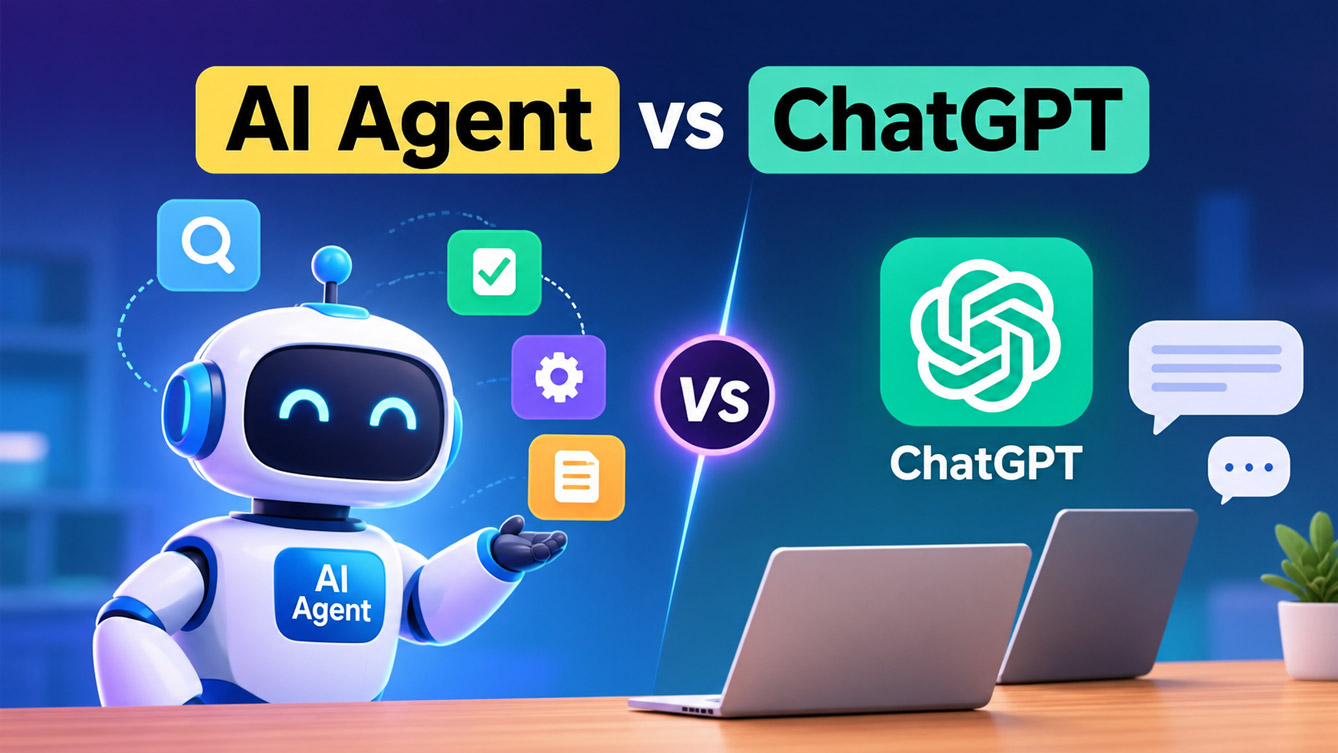
ChatGPT can help you decide what to do. An AI Agent can potentially help you actually do it.
For example, suppose you ask ChatGPT:
“Find me a good hotel in Chennai for this weekend.”
ChatGPT can explain what you should look for and may provide useful suggestions.
An AI Agent could potentially take the task further. It could search available hotels, compare prices, check your requirements, shortlist suitable options, and possibly complete a booking if you give it the required permission.
The important word here is action.
ChatGPT mainly responds to your instructions. An AI Agent can take a goal and work through multiple steps to complete it.
Think of ChatGPT as a Smart Brain
One simple comparison can make this even easier.
Think of ChatGPT as a very smart brain.
You ask a question, and the brain thinks about the request and gives you an answer.
Now imagine giving that brain access to a computer, calendar, email, browser, database, payment system, and other software tools.
Suddenly, the system can do much more than simply talk.
That combination of intelligence, tools, planning, and action creates something closer to an AI Agent.
This does not mean ChatGPT and AI Agents always exist as completely separate technologies. ChatGPT or another large language model can actually serve as the “brain” inside an AI Agent.
How Does an AI Agent Work?
You may now be wondering, “If an AI Agent can perform tasks, how does it actually know what to do?”
The process usually involves several important steps.
First, the AI Agent understands your goal.
Next, it breaks that goal into smaller tasks.
Then, it decides which tools or actions can help complete those tasks.
After that, it performs an action and checks what happened.
If the result does not match the goal, the agent can adjust its approach and try another step.
Finally, it can provide the completed result to you.
For example, imagine telling an AI Agent:
“Prepare a report about our website traffic this month.”
The agent could collect website data, analyze important numbers, identify changes, create charts, write observations, and prepare a report.
Instead of asking you to perform every individual step, the agent handles the workflow.
AI Agents Can Use Tools
One of the most important features of an AI Agent involves tools.
An AI Agent may connect with different software systems depending on what it needs to accomplish.
For example, an agent could potentially use:
- A web browser to search information
- A calendar to check appointments
- Email to communicate
- A spreadsheet to analyze numbers
- A database to retrieve information
- A payment system to process transactions
- Business software to update records
- APIs to communicate with other applications
This ability gives AI Agents much more practical power.
Imagine asking:
“Check today’s sales, compare them with last month, identify the biggest change, and email me a summary.”
A simple chatbot may explain how you could do those steps.
An AI Agent could potentially perform the workflow itself when it has the required access and permissions.
AI Agents Can Work Through Multiple Steps
Here is another major difference.
ChatGPT usually focuses on the conversation happening right now.
AI Agents can focus on a larger goal.
Suppose you tell an AI Agent:
“Find five potential customers for my web design business and prepare a list.”
The agent could potentially search relevant websites, collect business information, check whether those businesses need better websites, organize the information, and prepare a report.
That task contains many smaller actions.
The agent connects those actions together.
This ability to handle multiple steps makes AI Agents useful for business processes and repetitive work.
Can an AI Agent Make Decisions?
Yes, but there is an important point to remember.
AI Agents can make decisions within the rules, instructions, tools, and information available to them. However, businesses should not blindly allow an AI Agent to make every decision without human supervision.
For example, an agent might decide which data source to use or which document to analyze next.
However, sending a large payment, deleting important information, or signing a legal document should require appropriate human approval.
Therefore, human control remains extremely important.
The goal should not always be to remove humans from the process.
Instead, AI Agents can handle repetitive work while humans focus on decisions that require judgment, responsibility, and experience.
AI Agent vs ChatGPT: A Simple Example
Let’s make the difference even easier.
Imagine you own a website development company.
You tell ChatGPT:
“Write a follow-up email for a client who has not responded to my quotation.”
ChatGPT can write the email.
You then copy the email, open your email account, find the client, paste the message, and send it.
Now imagine an AI Agent with appropriate access.
You could say:
“Follow up with clients who received a quotation more than seven days ago and have not replied.”
The agent could check your records, identify those clients, prepare personalized emails, and send them after following your rules.
That is a significant difference.
ChatGPT helps you create the content.
An AI Agent can potentially manage the entire workflow.
Does That Mean ChatGPT Is Not an AI Agent?
Not necessarily.
This is where the topic can become confusing.
The terms “ChatGPT,” “AI assistant,” “AI Agent,” and “AI system” can describe different things depending on the product and its capabilities.
ChatGPT itself can provide much more than simple question-and-answer conversations. Modern AI systems can use tools, interact with information, and perform more complex workflows.
However, the concept of an AI Agent focuses strongly on goal-driven action and multi-step task execution.
So, rather than thinking about ChatGPT and AI Agents as two completely unrelated technologies, think of them as different ways of using AI.
A Simple Comparison: ChatGPT vs AI Agent
| Feature | ChatGPT | AI Agent |
| Answers questions | Yes | Yes |
| Generates content | Yes | Yes |
| Understands natural language | Yes | Yes |
| Follows instructions | Yes | Yes |
| Uses external tools | Depending on setup | Often designed around tool use |
| Handles multi-step workflows | Limited or task-dependent | Core capability |
| Takes actions | Limited or permission-dependent | Designed to take actions |
| Works toward a larger goal | Sometimes | Yes |
| Can make decisions during a workflow | Limited | Yes, within defined rules |
| Human approval | Often useful | Very important for sensitive actions |
The table gives us a simple picture.
ChatGPT focuses strongly on helping you through conversation. AI Agents focus strongly on achieving a goal through actions.
Where Can Businesses Use AI Agents?
Now comes the exciting part.
AI Agents can potentially change the way businesses handle everyday work.
Imagine a customer support agent that reads a customer’s question, checks the order database, identifies the issue, prepares a response, and updates the support ticket.
A sales agent could research potential customers, update CRM records, prepare follow-up messages, and remind salespeople about important leads.
A marketing agent could analyze campaign performance, identify weak areas, suggest improvements, and prepare reports.
A finance-related agent could organize financial information and prepare summaries, while sensitive financial decisions still require human approval.
The possibilities can grow as businesses connect AI with more software tools.
AI Agents in Everyday Life
AI Agents do not only belong to large companies.
They could eventually become useful for ordinary daily tasks too.
Imagine telling your personal AI:
“Plan my weekend trip.”
The agent could understand your preferences, check available options, create an itinerary, compare prices, and organize the information.
You could also say:
“Remind me about anything important I need to finish this week.”
Instead of simply showing a fixed reminder list, an AI system could potentially review your tasks, identify priorities, and help organize your week.
That sounds like a digital assistant that understands your goals rather than simply responding to commands.
Why Are Companies Interested in AI Agents?
Businesses constantly deal with repetitive tasks.
Employees spend time moving information between applications, checking reports, responding to routine questions, preparing documents, and following up with customers.
AI Agents could automate parts of these workflows.
As a result, employees could spend more time on creative work, customer relationships, strategy, and problem-solving.
However, companies also need to think carefully about security, privacy, accuracy, permissions, and accountability.
An AI Agent with access to important business systems needs strong controls.
Are AI Agents Perfect?
Absolutely not.
This point matters.
AI Agents can make mistakes. They can misunderstand instructions, use incorrect information, choose the wrong action, or produce an inaccurate result.
The more freedom an agent receives, the more carefully people need to control it.
For example, an AI Agent that drafts an email has relatively low risk.
An AI Agent that can send thousands of emails automatically creates a much bigger risk.
Similarly, an agent that recommends a product differs greatly from an agent that can purchase expensive products without asking for confirmation.
Therefore, good AI Agent design needs permissions, limits, monitoring, and human oversight.
What About the Future of AI Agents?
The future could become very interesting.
Today, many people use AI by opening a chatbot and asking questions.
Tomorrow, people may increasingly describe the result they want instead.
Instead of saying:
“How do I create a monthly sales report?”
you might say:
“Create my monthly sales report and highlight anything that needs my attention.”
That small change represents a big shift.
We move from asking AI for answers toward asking AI to accomplish goals.
This shift could affect websites, software applications, customer service, marketing, education, finance, healthcare, programming, and many other industries.
Will AI Agents Replace Humans?
This question probably comes to everyone’s mind.
The answer depends on how organizations use them.
AI Agents can automate many repetitive tasks, but humans still provide judgment, creativity, empathy, responsibility, and real-world understanding.
Instead of thinking only about “AI replacing humans,” it may make more sense to think about humans working with AI Agents.
A person who knows how to use AI effectively may complete certain types of work much faster.
That could change the skills companies look for in the future.
The Real Difference in One Sentence
If you remember only one thing from this article, remember this:
ChatGPT can help you with a task, while an AI Agent can potentially take responsibility for completing a larger task through multiple actions.
Of course, the exact capabilities depend on the AI system, available tools, permissions, and the task itself.
Still, this simple idea helps explain why AI Agents have attracted so much attention.
Frequently Asked Questions About AI Agents
1. What is an AI Agent in simple words?
An AI Agent is an AI system that can understand a goal, plan multiple steps, use tools, and perform actions to complete that goal. Instead of only giving you an answer, it can potentially help carry out the work.
2. Is ChatGPT an AI Agent?
ChatGPT and AI Agents are not exactly the same thing. ChatGPT mainly provides conversational assistance, while an AI Agent focuses more strongly on completing goals through multiple steps and actions. Some AI systems can combine conversational AI with agent-like capabilities.
3. What can an AI Agent do?
An AI Agent can potentially search information, analyze data, use software tools, organize information, prepare documents, communicate with systems, and complete multi-step workflows. Its capabilities depend on the tools and permissions that developers provide.
4. Are AI Agents safe to use?
AI Agents can provide useful automation, but they can also make mistakes. Businesses should use appropriate permissions, security controls, monitoring, and human approval for sensitive actions.
5. Will AI Agents replace ChatGPT?
AI Agents do not necessarily replace ChatGPT. Instead, conversational AI can become one part of an AI Agent. Think of ChatGPT as a way to interact with AI, while an AI Agent focuses more on taking actions to achieve a goal.
Final Thoughts
The biggest change in artificial intelligence may not come from AI simply becoming better at answering questions. The bigger change may come when AI starts helping us complete the work behind those questions.
Today, you might ask AI, “How can I do this?”
Tomorrow, you may simply say, “Please do this.”
That difference sounds small, but it could completely change the way we interact with computers.
So, the next time someone tells you about an AI Agent, remember this simple idea: a chatbot talks with you, while an agent can work toward a goal for you.
Now think about your own daily work. If you had an AI Agent that could safely handle one repetitive task for you every day, what would you ask it to do?
Maybe that simple question gives us a glimpse of where computing is heading next. And if you know someone who still thinks AI only means “asking ChatGPT questions,” perhaps it is time to share this article with them.